
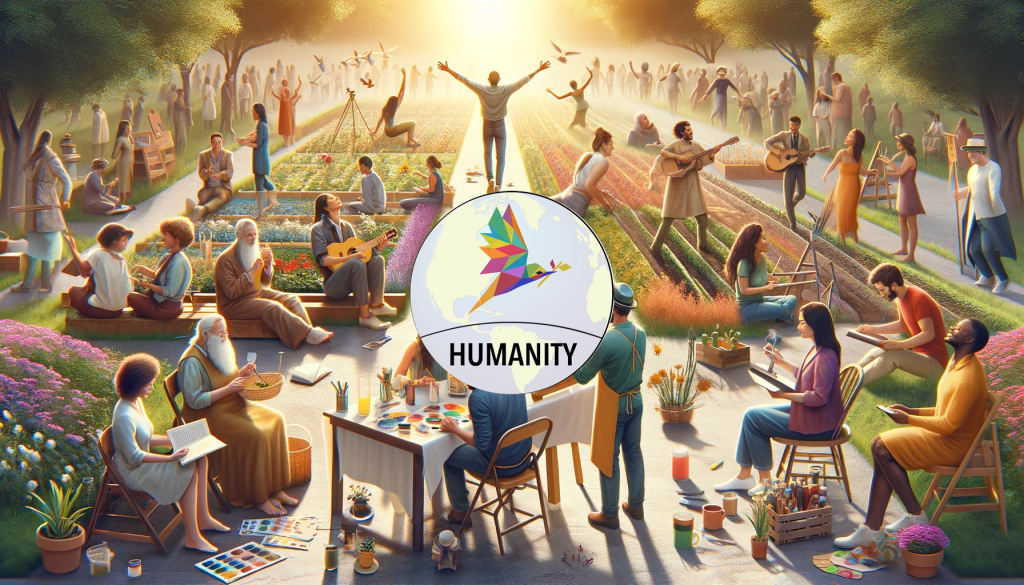
The first point of the Humanity movement’s program is the establishment of a universal income of at least €1,200 per month (figure for Italy to be adjusted according to the cost of living and inflation for each country) through:
- Taxation of large international assets and billionaire companies (see Credit Suisse 2022 report at the bottom)
- Complete automation of jobs currently performed by humans (See Berkeley University article 2023 at the bottom)
- Election of central bank leaders for the coordination of the taxation operation and support of part of the public expenditure and the universal income.
In addition to the establishment of universal income, our program provides for the re-education of the population to an identity that is no longer based on the work they perform but on the deeper meaning of “being human” through:
- Creation of a free portal on the Metaverse for “working on oneself”.
- Provision of visor or smartphone for content access
- Assignment of a personalized and dedicated non-human AI tutor to each individual acting as a life and spiritual coach
Universal Income: Data and Sources Supporting the Program
According to a report mentioned in Nexus Editions, the richest 0.5% of people control more than 35% of global wealth. The Credit Suisse Global Wealth Report 2022 provides a more detailed overview of the distribution of global wealth: According to the report, aggregated global wealth was forecast at $463.6 trillion at the end of 2021. Growth was 9.8% compared to 2020. About 53% of adults worldwide, or 2.8 billion people, had wealth less than $10,000 in 2021. The global middle class, with wealth between $10,000 and $100,000, saw the most significant growth, tripling in size since 2000. The upper-middle class, with wealth between $100,000 and $1 million, also tripled in size. Finally, the high net worth group, i.e., millionaires, represents only 1.2% of adults but is rapidly growing.
List of assets of the richest in America and Europe according to Forbes:
AMERICA 2022
*Elon Musk: Net worth of $180 billion, derived from Tesla, SpaceX, and other ventures.
- Jeff Bezos: Net worth of $114 billion, founder of Amazon.
- Larry Ellison: Net worth of $107 billion, co-founder of Oracle.
- Warren Buffett: Net worth of $106 billion, linked to his company Berkshire Hathaway.
- Bill Gates: Net worth of $104 billion, co-founder of Microsoft.
- Michael Bloomberg: Net worth of $94.5 billion, founder of Bloomberg L.P.
- Carlos Slim Helu and family: Net worth of $93 billion, entrepreneur in the telecommunications sector.
- Mukesh Ambani: Net worth of $83.4 billion, active in various sectors.
- Steve Ballmer: Net worth of $80.7 billion, former CEO of Microsoft.
EUROPE 2022
- Bernard Arnault (France): $158 billion.
- Francoise Bettencourt Meyers (France): $74 billion.
- Amancio Ortega (Spain): $59 billion.
- Dieter Schwarz (Germany): $47 billion.
- Rodolphe Saade (France): $41 billion.
- Francois Pinault (France): $40 billion.
- Klaus Michael Kuehne (Germany): $37 billion.
- Beate Heister & Karl Albrecht Jr (Germany): $36 billion.
- Giovanni Ferrero (Italy): $36 billion.
- Alain and Gerard Wertheimer (France): $31 billion each.
Useful links: https://www.credit-suisse.com/media/assets/corporate/docs/about-us/research/publications/global-wealth-report-2022-en.pdf
https://nexusedizioni.it/en/CT/statistical-data-on-wealth-distribution-533b2c31250c8/
Total Automation: Data and Sources Supporting the Program (abstract from the scientific article):
“In the largest survey of its kind, we interviewed 2,778 researchers who have published in major areas of artificial intelligence (AI), asking them for predictions on the pace of AI progress and the nature and impacts of advanced AI systems. The aggregate forecasts give at least a 50% chance that AI systems will reach various milestones by 2028, including the autonomous construction of a payment processing site, the creation of a song indistinguishable from a new song by a popular musician, and autonomy in downloading and refining a large language model. If science continues uninterrupted, the likelihood that machines unaided will surpass humans in every possible task has been estimated at 10% by 2027 and 50% by 2047. The latter estimate is 13 years earlier than that reached in a similar survey conducted just one year earlier [Grace et al., 2022]. However, the possibility that all human occupations become fully automatable is predicted at 10% by 2037 and 50% no sooner than 2116 (compared to 2164 in the 2022 survey). Most respondents expressed considerable uncertainty about the long-term value of AI progress: while 68.3% believe that positive outcomes from superhuman AI are more likely than negative ones, among these net optimists, 48% gave at least a 5% chance to extremely negative outcomes such as human extinction, and 59% of net pessimists gave 5% or more to extremely positive outcomes. Between 37.8% and 51.4% of respondents gave at least a 10% chance that advanced AI will lead to negative outcomes such as human extinction. More than half suggested that “substantial” or “extreme” attention is justified for six different AI-related scenarios, including the spread of false information, authoritarian control of the population, and worsening inequalities. There was disagreement on whether faster or slower AI progress would be better for the future of humanity. However, there was broad consensus that research aimed at minimizing the potential risks of AI systems should be more highly prioritized.”
Research link with graphs and details: https://arxiv.org/pdf/2401.02843.pdf
 HUMAN ADVISOR PROJECT
Un pensiero su “UNIVERSAL INCOME”