
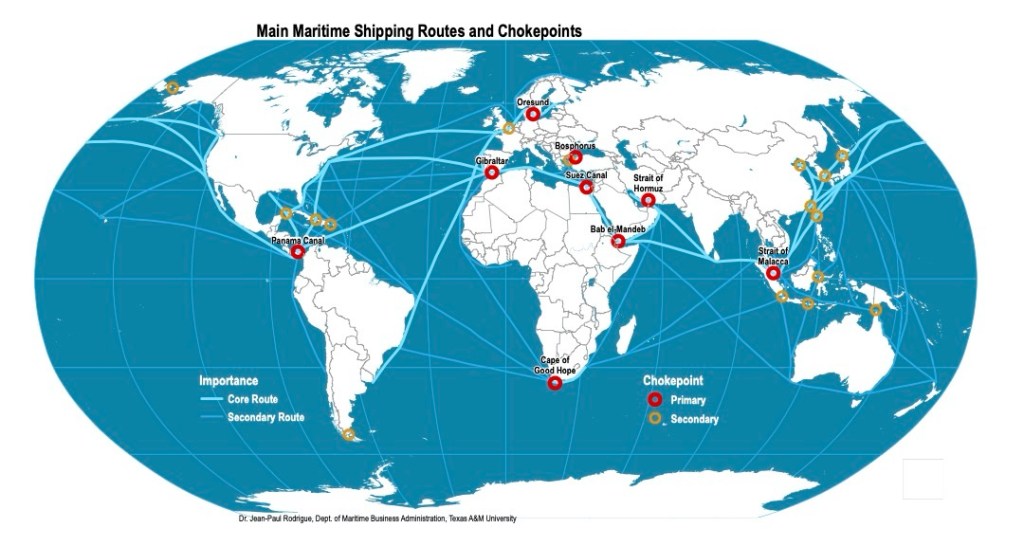
To understand what is happening in the world today, we must start from a simple yet powerful idea: globalization is, above all, control of the seas. It is not just about trade, technology, or financial flows, but about the ability to ensure—or block—the free transit of goods and energy along the world’s major maritime routes.
History teaches this clearly. Every dominant empire has built its power through strategic control of the waters: Rome unified the Mediterranean, turning it into an internal lake—“mare nostrum”; the British Empire established naval bases across the globe, from the Suez Canal to Singapore; and finally, the United States, which since the end of World War II has dominated the oceans, sustaining the liberal global order with an unrivaled navy.
But no hegemony, however solid, remains unchallenged forever.
⸻
The American Empire in a Phase of Fatigue
Today, the United States still appears formally dominant, but less capable of exercising its authority unopposed. It is not so much a military weakness as a perceptual fatigue—a loss of confidence, both domestically and internationally, that creates room for other powers to rise. This perception—and the reality that follows—carries tremendous weight: in international relations, the perception of strength is already strength, just as the perception of weakness is already an invitation to challenge.
It is into this vacuum that determined actors are stepping: China, Russia, Turkey, and Iran, each carrying a worldview and, often, a historical empire to which they appeal to legitimize their expansion.
⸻
The Return of Empires
It is no coincidence that these emerging powers explicitly reference history. The United States sees itself as the heir to the British Empire—not just linguistically and culturally, but as a global maritime guardian. China, with its millennia-old civilization, has revived the Belt and Road Initiative, not only by land but especially by sea, building strategic ports from Asia to Africa. Russia aims to reconstruct a post-Soviet sphere of influence, supported by a czarist and Orthodox vision. Turkey, nostalgic for Ottoman glory, is now very active in the Eastern Mediterranean and Syria. And Iran presents itself as the spiritual and geopolitical heir of the Persian Empire, with a regional agenda aimed at shaping the broader Middle East.
These actors are not merely competing symbolically. They have concrete goals: regional influence, market access, energy control, and military presence in key global hotspots. And all of these goals, inevitably, pass through the sea.
⸻
The New Map of Power: Strategic Straits
If the seas are the arteries of globalization, the straits are its vital points. They are narrow spaces where everything passes—and where everything can be blocked. This makes them the true fault lines of modern geopolitics.
The Suez Canal links Europe to Asia; even a partial closure causes immediate price shocks globally. The Bosporus and Dardanelles, controlled by Turkey, are essential for Russia and the entire Black Sea region. The Strait of Gibraltar remains a critical gateway to the Mediterranean. The Bab-el-Mandeb, between Yemen and the Horn of Africa, connects the Red Sea to the Indian Ocean, with direct consequences for European energy security.
The Strait of Hormuz may be the most delicate of all: nearly one-third of the world’s oil passes through it. Every Iran–U.S. tension plays out here as well. The Strait of Malacca, by contrast, is vital for China: a major portion of its trade flows through it, making it extremely sensitive in any potential conflict.
Further north, the Bering Strait—between Alaska and Siberia—gains relevance, not only symbolically as a frontier between two superpowers but also strategically in a world where Arctic routes are becoming navigable. Finally, the Taiwan Strait is now the epicenter of global tension: a geopolitical flashpoint where economic, technological, and military interests intersect.
⸻
Ongoing Wars: Symptoms of a Reordered World
Each current conflict can be interpreted as an attempt to redefine the global order. The war in Ukraine is not simply a clash between two states but a Russian challenge to NATO expansion and its own post-Soviet marginalization. In Syria, Turkey intervenes to control Kurdish dynamics and safeguard its regional influence. In Gaza, Iran strengthens its role in the anti-Israel axis and within the broader Middle Eastern theater.
Tensions around Taiwan may be the most dangerous: China claims the island as its own, and any attempt at reunification—even by force—would mark a critical turning point in its standoff with the United States. For now, Washington responds economically, using tariffs and technological restrictions in an effort to slow Chinese military and digital development without triggering open warfare.
⸻
A World Reassembling: Between Power, Narrative, and Perception
The Taiwan case is more than a territorial dispute. It is the symbolic center of a much broader challenge: that between two worldviews. On one side, a liberal, multilateral order led by the United States, which has provided decades of maritime stability and commercial growth. On the other, a new multipolar order in which emerging powers demand more space, influence, and control over strategic routes and global flows.
But the real battle is not just over who rules, but how reality is told and perceived. Narrative power matters as much as military power. China and Russia are not only challenging U.S. dominance at sea—they are also attacking its moral, cultural, and economic primacy. In this sense, the conflict also plays out in the minds of public opinion and in the diplomacy of neutral or non-aligned nations.
Globalization is not over—but it is changing its face. From an integrated, Western-led system, we are shifting to a more fragmented mosaic, where each power seeks to defend its sphere of influence, even at the expense of global cooperation. In this context, seas, straits, ports, and canals become arenas of strategic competition once again. It is the return of infrastructure geopolitics and chokepoint diplomacy.
⸻
Economic Impacts and New Financial Strategies
This new global context does not remain confined to diplomacy or armed conflict: it has direct and deep effects on financial markets. Wars, sanctions, naval blockades, geopolitical realignments, and trade tensions make future scenarios increasingly uncertain and volatile.
The consequences are visible across at least three dimensions:
1. Structural inflation: supply chain disruptions and the race for strategic self-sufficiency (in energy, tech, raw materials) are driving up global costs.
2. Market volatility: instability is growing—not only in countries directly involved in conflicts but at a systemic level.
3. End of the linear paradigm: predictable, steady growth models are becoming obsolete, prompting a fundamental rethink of risk itself.
In this setting, traditional passive investment strategies—like recurring index-based plans (e.g., PACs)—are showing their limitations. While still valid for long-term retail investors, they no longer suffice for those seeking resilience in a multipolar, high-entropy world.
Thus, we are witnessing a return—or rather a reinforcement—of more dynamic and adaptive approaches, such as those labeled “Absolute Return” strategies. These are not brand new: they have existed in institutional portfolios for decades. But their relevance increases in scenarios where the goal is not to beat the market, but to protect capital across all market phases.
Absolute Return strategies may include:
• Long/short instruments, which can profit in both rising and falling markets;
• Active hedging against inflation, volatility, or geopolitical shocks;
• Selective exposure to currencies, commodities, or assets uncorrelated with traditional markets.
Additionally, multi-strategy models are gaining traction—blending quantitative algorithms, macroeconomic analysis, and geopolitical intelligence—to deliver stable, non-cyclical returns.
In short: in a world where global powers are contesting control of the seas, investors must redraw their mental maps. Sailing blind is no longer an option, nor is following routes set by past textbooks. A new compass is needed—one capable of navigating not just quarterly earnings and equity indices, but the Strait of Hormuz, tech tariffs, and capital flows chasing the next strategic alliance.
Gianpaolo Marcucci
 HUMAN ADVISOR PROJECT