To understand what is happening in the world today, we must start from a simple yet powerful idea: globalization is, above all, control of the seas. It is not just about trade, technology, or financial flows, but about the ability to ensure—or block—the free transit of goods and energy along the world’s major maritime routes.
History teaches this clearly. Every dominant empire has built its power through strategic control of the waters: Rome unified the Mediterranean, turning it into an internal lake—“mare nostrum”; the British Empire established naval bases across the globe, from the Suez Canal to Singapore; and finally, the United States, which since the end of World War II has dominated the oceans, sustaining the liberal global order with an unrivaled navy.
But no hegemony, however solid, remains unchallenged forever.
⸻
The American Empire in a Phase of Fatigue
Today, the United States still appears formally dominant, but less capable of exercising its authority unopposed. It is not so much a military weakness as a perceptual fatigue—a loss of confidence, both domestically and internationally, that creates room for other powers to rise. This perception—and the reality that follows—carries tremendous weight: in international relations, the perception of strength is already strength, just as the perception of weakness is already an invitation to challenge.
It is into this vacuum that determined actors are stepping: China, Russia, Turkey, and Iran, each carrying a worldview and, often, a historical empire to which they appeal to legitimize their expansion.
⸻
The Return of Empires
It is no coincidence that these emerging powers explicitly reference history. The United States sees itself as the heir to the British Empire—not just linguistically and culturally, but as a global maritime guardian. China, with its millennia-old civilization, has revived the Belt and Road Initiative, not only by land but especially by sea, building strategic ports from Asia to Africa. Russia aims to reconstruct a post-Soviet sphere of influence, supported by a czarist and Orthodox vision. Turkey, nostalgic for Ottoman glory, is now very active in the Eastern Mediterranean and Syria. And Iran presents itself as the spiritual and geopolitical heir of the Persian Empire, with a regional agenda aimed at shaping the broader Middle East.
These actors are not merely competing symbolically. They have concrete goals: regional influence, market access, energy control, and military presence in key global hotspots. And all of these goals, inevitably, pass through the sea.
⸻
The New Map of Power: Strategic Straits
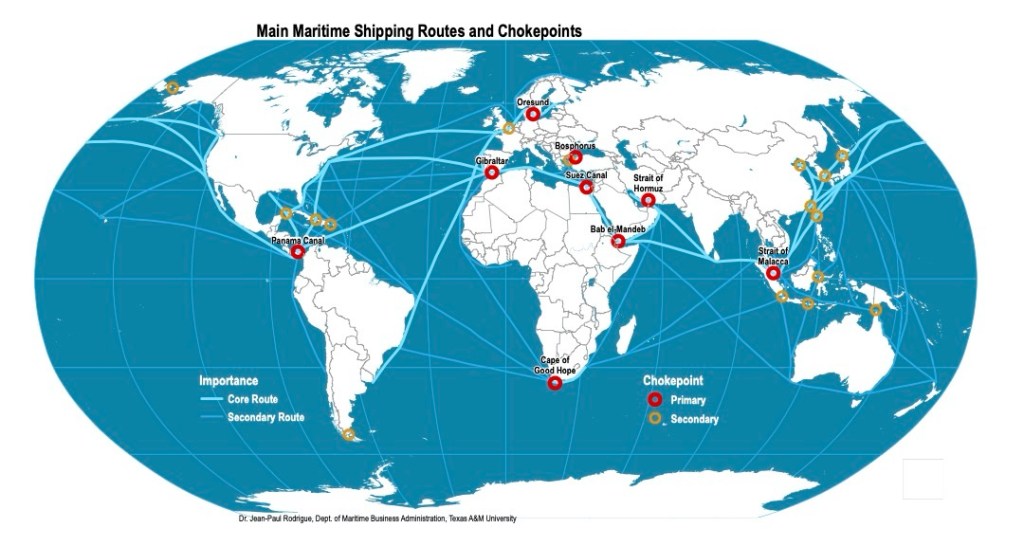
If the seas are the arteries of globalization, the straits are its vital points. They are narrow spaces where everything passes—and where everything can be blocked. This makes them the true fault lines of modern geopolitics.
The Suez Canal links Europe to Asia; even a partial closure causes immediate price shocks globally. The Bosporus and Dardanelles, controlled by Turkey, are essential for Russia and the entire Black Sea region. The Strait of Gibraltar remains a critical gateway to the Mediterranean. The Bab-el-Mandeb, between Yemen and the Horn of Africa, connects the Red Sea to the Indian Ocean, with direct consequences for European energy security.
The Strait of Hormuz may be the most delicate of all: nearly one-third of the world’s oil passes through it. Every Iran–U.S. tension plays out here as well. The Strait of Malacca, by contrast, is vital for China: a major portion of its trade flows through it, making it extremely sensitive in any potential conflict.
Further north, the Bering Strait—between Alaska and Siberia—gains relevance, not only symbolically as a frontier between two superpowers but also strategically in a world where Arctic routes are becoming navigable. Finally, the Taiwan Strait is now the epicenter of global tension: a geopolitical flashpoint where economic, technological, and military interests intersect.
⸻
Ongoing Wars: Symptoms of a Reordered World
Each current conflict can be interpreted as an attempt to redefine the global order. The war in Ukraine is not simply a clash between two states but a Russian challenge to NATO expansion and its own post-Soviet marginalization. In Syria, Turkey intervenes to control Kurdish dynamics and safeguard its regional influence. In Gaza, Iran strengthens its role in the anti-Israel axis and within the broader Middle Eastern theater.
Tensions around Taiwan may be the most dangerous: China claims the island as its own, and any attempt at reunification—even by force—would mark a critical turning point in its standoff with the United States. For now, Washington responds economically, using tariffs and technological restrictions in an effort to slow Chinese military and digital development without triggering open warfare.
⸻
A World Reassembling: Between Power, Narrative, and Perception
The Taiwan case is more than a territorial dispute. It is the symbolic center of a much broader challenge: that between two worldviews. On one side, a liberal, multilateral order led by the United States, which has provided decades of maritime stability and commercial growth. On the other, a new multipolar order in which emerging powers demand more space, influence, and control over strategic routes and global flows.
But the real battle is not just over who rules, but how reality is told and perceived. Narrative power matters as much as military power. China and Russia are not only challenging U.S. dominance at sea—they are also attacking its moral, cultural, and economic primacy. In this sense, the conflict also plays out in the minds of public opinion and in the diplomacy of neutral or non-aligned nations.
Globalization is not over—but it is changing its face. From an integrated, Western-led system, we are shifting to a more fragmented mosaic, where each power seeks to defend its sphere of influence, even at the expense of global cooperation. In this context, seas, straits, ports, and canals become arenas of strategic competition once again. It is the return of infrastructure geopolitics and chokepoint diplomacy.
⸻
Economic Impacts and New Financial Strategies
This new global context does not remain confined to diplomacy or armed conflict: it has direct and deep effects on financial markets. Wars, sanctions, naval blockades, geopolitical realignments, and trade tensions make future scenarios increasingly uncertain and volatile.
The consequences are visible across at least three dimensions:
1. Structural inflation: supply chain disruptions and the race for strategic self-sufficiency (in energy, tech, raw materials) are driving up global costs.
2. Market volatility: instability is growing—not only in countries directly involved in conflicts but at a systemic level.
3. End of the linear paradigm: predictable, steady growth models are becoming obsolete, prompting a fundamental rethink of risk itself.
In this setting, traditional passive investment strategies—like recurring index-based plans (e.g., PACs)—are showing their limitations. While still valid for long-term retail investors, they no longer suffice for those seeking resilience in a multipolar, high-entropy world.
Thus, we are witnessing a return—or rather a reinforcement—of more dynamic and adaptive approaches, such as those labeled “Absolute Return” strategies. These are not brand new: they have existed in institutional portfolios for decades. But their relevance increases in scenarios where the goal is not to beat the market, but to protect capital across all market phases.
Absolute Return strategies may include:
• Long/short instruments, which can profit in both rising and falling markets;
• Active hedging against inflation, volatility, or geopolitical shocks;
• Selective exposure to currencies, commodities, or assets uncorrelated with traditional markets.
Additionally, multi-strategy models are gaining traction—blending quantitative algorithms, macroeconomic analysis, and geopolitical intelligence—to deliver stable, non-cyclical returns.
In short: in a world where global powers are contesting control of the seas, investors must redraw their mental maps. Sailing blind is no longer an option, nor is following routes set by past textbooks. A new compass is needed—one capable of navigating not just quarterly earnings and equity indices, but the Strait of Hormuz, tech tariffs, and capital flows chasing the next strategic alliance.
To understand what is happening in the world today, we must start from a simple yet powerful idea: globalization is, above all, control of the seas. It is not just about trade, technology, or financial flows, but about the ability to ensure—or block—the free transit of goods and energy along the world’s major maritime routes.
History teaches this clearly. Every dominant empire has built its power through strategic control of the waters: Rome unified the Mediterranean, turning it into an internal lake—“mare nostrum”; the British Empire established naval bases across the globe, from the Suez Canal to Singapore; and finally, the United States, which since the end of World War II has dominated the oceans, sustaining the liberal global order with an unrivaled navy.
But no hegemony, however solid, remains unchallenged forever.
⸻
The American Empire in a Phase of Fatigue
Today, the United States still appears formally dominant, but less capable of exercising its authority unopposed. It is not so much a military weakness as a perceptual fatigue—a loss of confidence, both domestically and internationally, that creates room for other powers to rise. This perception—and the reality that follows—carries tremendous weight: in international relations, the perception of strength is already strength, just as the perception of weakness is already an invitation to challenge.
It is into this vacuum that determined actors are stepping: China, Russia, Turkey, and Iran, each carrying a worldview and, often, a historical empire to which they appeal to legitimize their expansion.
⸻
The Return of Empires
It is no coincidence that these emerging powers explicitly reference history. The United States sees itself as the heir to the British Empire—not just linguistically and culturally, but as a global maritime guardian. China, with its millennia-old civilization, has revived the Belt and Road Initiative, not only by land but especially by sea, building strategic ports from Asia to Africa. Russia aims to reconstruct a post-Soviet sphere of influence, supported by a czarist and Orthodox vision. Turkey, nostalgic for Ottoman glory, is now very active in the Eastern Mediterranean and Syria. And Iran presents itself as the spiritual and geopolitical heir of the Persian Empire, with a regional agenda aimed at shaping the broader Middle East.
These actors are not merely competing symbolically. They have concrete goals: regional influence, market access, energy control, and military presence in key global hotspots. And all of these goals, inevitably, pass through the sea.
⸻
The New Map of Power: Strategic Straits
If the seas are the arteries of globalization, the straits are its vital points. They are narrow spaces where everything passes—and where everything can be blocked. This makes them the true fault lines of modern geopolitics.
The Suez Canal links Europe to Asia; even a partial closure causes immediate price shocks globally. The Bosporus and Dardanelles, controlled by Turkey, are essential for Russia and the entire Black Sea region. The Strait of Gibraltar remains a critical gateway to the Mediterranean. The Bab-el-Mandeb, between Yemen and the Horn of Africa, connects the Red Sea to the Indian Ocean, with direct consequences for European energy security.
The Strait of Hormuz may be the most delicate of all: nearly one-third of the world’s oil passes through it. Every Iran–U.S. tension plays out here as well. The Strait of Malacca, by contrast, is vital for China: a major portion of its trade flows through it, making it extremely sensitive in any potential conflict.
Further north, the Bering Strait—between Alaska and Siberia—gains relevance, not only symbolically as a frontier between two superpowers but also strategically in a world where Arctic routes are becoming navigable. Finally, the Taiwan Strait is now the epicenter of global tension: a geopolitical flashpoint where economic, technological, and military interests intersect.
⸻
Ongoing Wars: Symptoms of a Reordered World
Each current conflict can be interpreted as an attempt to redefine the global order. The war in Ukraine is not simply a clash between two states but a Russian challenge to NATO expansion and its own post-Soviet marginalization. In Syria, Turkey intervenes to control Kurdish dynamics and safeguard its regional influence. In Gaza, Iran strengthens its role in the anti-Israel axis and within the broader Middle Eastern theater.
Tensions around Taiwan may be the most dangerous: China claims the island as its own, and any attempt at reunification—even by force—would mark a critical turning point in its standoff with the United States. For now, Washington responds economically, using tariffs and technological restrictions in an effort to slow Chinese military and digital development without triggering open warfare.
⸻
A World Reassembling: Between Power, Narrative, and Perception
The Taiwan case is more than a territorial dispute. It is the symbolic center of a much broader challenge: that between two worldviews. On one side, a liberal, multilateral order led by the United States, which has provided decades of maritime stability and commercial growth. On the other, a new multipolar order in which emerging powers demand more space, influence, and control over strategic routes and global flows.
But the real battle is not just over who rules, but how reality is told and perceived. Narrative power matters as much as military power. China and Russia are not only challenging U.S. dominance at sea—they are also attacking its moral, cultural, and economic primacy. In this sense, the conflict also plays out in the minds of public opinion and in the diplomacy of neutral or non-aligned nations.
Globalization is not over—but it is changing its face. From an integrated, Western-led system, we are shifting to a more fragmented mosaic, where each power seeks to defend its sphere of influence, even at the expense of global cooperation. In this context, seas, straits, ports, and canals become arenas of strategic competition once again. It is the return of infrastructure geopolitics and chokepoint diplomacy.
⸻
Economic Impacts and New Financial Strategies
This new global context does not remain confined to diplomacy or armed conflict: it has direct and deep effects on financial markets. Wars, sanctions, naval blockades, geopolitical realignments, and trade tensions make future scenarios increasingly uncertain and volatile.
The consequences are visible across at least three dimensions:
1. Structural inflation: supply chain disruptions and the race for strategic self-sufficiency (in energy, tech, raw materials) are driving up global costs.
2. Market volatility: instability is growing—not only in countries directly involved in conflicts but at a systemic level.
3. End of the linear paradigm: predictable, steady growth models are becoming obsolete, prompting a fundamental rethink of risk itself.
In this setting, traditional passive investment strategies—like recurring index-based plans (e.g., PACs)—are showing their limitations. While still valid for long-term retail investors, they no longer suffice for those seeking resilience in a multipolar, high-entropy world.
Thus, we are witnessing a return—or rather a reinforcement—of more dynamic and adaptive approaches, such as those labeled “Absolute Return” strategies. These are not brand new: they have existed in institutional portfolios for decades. But their relevance increases in scenarios where the goal is not to beat the market, but to protect capital across all market phases.
Absolute Return strategies may include:
• Long/short instruments, which can profit in both rising and falling markets;
• Active hedging against inflation, volatility, or geopolitical shocks;
• Selective exposure to currencies, commodities, or assets uncorrelated with traditional markets.
Additionally, multi-strategy models are gaining traction—blending quantitative algorithms, macroeconomic analysis, and geopolitical intelligence—to deliver stable, non-cyclical returns.
In short: in a world where global powers are contesting control of the seas, investors must redraw their mental maps. Sailing blind is no longer an option, nor is following routes set by past textbooks. A new compass is needed—one capable of navigating not just quarterly earnings and equity indices, but the Strait of Hormuz, tech tariffs, and capital flows chasing the next strategic alliance.
Geopolitics: How Did We Get Here? U.S. Mistakes and Imperial Fatigue
Geopolitics: Where Are We Going? Perspectives and Future Scenarios
Geopolitics: How Do We Prepare? Strategies for Italy in the Era of Contested Hegemony
1. Geopolitics: Where Are We?
Introduction: The Contested Hegemony of the United States
To understand contemporary geopolitics, it is fundamental to analyze the current context of the international order, characterized by an increasingly contested American hegemony. In this part of the lecture, we will explore the global landscape where the United States, while still being a dominant power, must face growing difficulties in maintaining its primacy due to competition with other international actors. We will analyze how the unipolar order, established at the end of the Cold War, is transforming into a multipolar system, characterized by emerging rivalries and increasing uncertainty. This transformation forces us to reflect on how power dynamics are rapidly changing and how these changes are influencing international relations.
In particular, we will analyze the rise of new geopolitical actors such as China, Russia, and Iran, the resulting economic and technological challenges, the United States’ reaction to these developments, and the emergence of a multipolar system. The focus will be on how the transformation of global power influences not only U.S. foreign policy but also the entire geopolitical framework, making it increasingly fragmented and unstable.
1.1 The New Geopolitical Complexity: The End of the Unipolar Order
After the collapse of the Soviet Union in 1991, the United States enjoyed a position of global predominance, a true unipolar hegemony. However, today this dominance is contested by new emerging actors, particularly China, Russia, and Iran, who propose alternative visions to the liberal order promoted by Washington. The current geopolitical scenario can therefore be described as a phase of contested hegemony, in which the United States must constantly confront global dynamics that reduce its room for maneuver.
In the years following 1991, there was a belief in the United States and Western countries that economic and political liberalism would triumph globally, ushering in an era of stability and prosperity. However, this idea of the “end of history,” as theorized by Francis Fukuyama, proved illusory. The current reality shows a much more complex and competitive world, in which the United States must face challenges that go beyond the military sphere, involving economic, technological, and cultural dimensions. This new geopolitical reality is characterized by local conflicts, technological competition, trade tensions, and ideological rivalries that make the management of international relations increasingly difficult.
The end of the unipolar order implies not only a reduction in American influence but also increasing global uncertainty. While the United States remains a dominant military and economic power, it can no longer count on unanimous international consensus. Global dynamics have become more fragmented, with fluid alliances and emerging conflicts challenging Washington’s ability to dictate the global agenda. Furthermore, the crisis of multilateralism and the weakening of international institutions have further complicated the United States’ ability to maintain a stable global order.
1.2 The Rise of China: The Economic and Technological Challenge
China is undoubtedly the main challenger to U.S. supremacy. Its economic growth over the past thirty years has been extraordinary, transforming the country from a developing economy into one of the world’s major economic powers. China has been able to make the most of globalization, attracting foreign investment and developing a powerful industrial and technological network. Its model, which combines state capitalism with authoritarian political control, has proven extremely effective in ensuring rapid and sustained growth.
The Belt and Road Initiative, launched in 2013, represents the clearest example of China’s ambition to extend its influence on a global scale. Through infrastructure investments in Asia, Africa, and Europe, Beijing is building a network of economic and political relations that directly challenges American hegemony. This strategy has allowed China not only to increase its economic weight but also to consolidate strategic alliances in areas of the world often neglected by the West, creating a network of dependencies that strengthen its geopolitical role.
Chinese growth is not only economic but also technological: China is at the forefront in developing technologies such as 5G, artificial intelligence, and digital surveillance, which represent strategic sectors for future global competition. Through substantial investments in research and development, Beijing has built a technological infrastructure that rivals the American one and, in some sectors, surpasses it. Chinese leadership in these areas not only guarantees significant economic advantages but also allows it to exercise increasing geopolitical influence, as many nations have become dependent on Chinese technologies for their critical infrastructure.
1.3 Russia: Geopolitical Revanchism
Russia, while not having the same economic power as China, remains a key player in the international system. Under Vladimir Putin’s leadership, Moscow has adopted a foreign policy aimed at recovering the prestige and influence lost after the Soviet Union’s collapse. Russia views NATO’s eastward expansion as a direct threat to its security and has responded aggressively to reaffirm its sphere of influence, especially in former Soviet bloc countries.
The war in Ukraine, which began in 2014 with the annexation of Crimea and continued with the conflict in Donbass, is a clear example of this policy of reaction against Western expansion. Russia has sought to block Ukraine’s rapprochement with Europe and NATO through direct actions and support for separatist movements. This conflict has brought Europe back to a state of tension similar to that of the Cold War, where spheres of influence are once again at the center of geopolitical strategy.
The Russian strategy is based on a combined use of military force, hybrid warfare, and energy diplomacy. Hybrid warfare represents one of the most innovative elements of Russian foreign policy, combining conventional military operations with cyber attacks, disinformation, and intelligence operations aimed at destabilizing adversaries. Moscow’s ability to influence elections and fuel social discontent in various Western countries has demonstrated the effectiveness of this strategy in undermining Western unity and strengthening its position.
1.4 Iran: Regional Influence and the Challenge to Western Order
Iran represents another fundamental actor that is challenging American hegemony, especially in the Middle East. After the 1979 Islamic revolution, Iran has sought to build its own regional sphere of influence, openly challenging the order supported by the United States and its allies in the region, such as Israel and Saudi Arabia. Iran has used a combination of diplomacy, support for paramilitary groups, and nuclear development programs to increase its influence and consolidate a position of power in the region.
One of the main tools of Iranian influence is support for paramilitary groups and militias in countries like Lebanon, Syria, Iraq, and Yemen. Through support for Hezbollah, Shiite militias in Iraq, and the Houthi rebels in Yemen, Tehran has managed to build a network of alliances that allows it to extend its influence and directly counter U.S. and Saudi interests in the region. This policy has led to growing tension with the United States and has made the Middle East one of the main theaters of global geopolitical competition.
The Iranian nuclear program represents another key factor in regional and international tension. Iran has developed a nuclear program that has raised concerns among the United States and its allies, particularly Israel, which fears that Tehran might acquire the capability to develop nuclear weapons. The Abraham Accords, signed between Israel and some Arab countries, represent an attempt to create a common front against Iran and stabilize the region through new alliances. However, as observed by Dario Fabbri, Iran has sought to counter this process by destabilizing the region, as demonstrated by Hamas’s attacks against Israel, which Tehran has indirectly supported to prevent the normalization of relations between Israel and Arab countries.
Iran’s strategy is therefore aimed at maintaining high tension and preventing the Abraham Accords from consolidating as a new regional security architecture that would isolate Tehran. Through support for non-state actors and through its influence in Syria, Iran seeks to prevent Israel and its new Arab allies from building a stable and united bloc against it. This approach has contributed to making the Israeli-Palestinian conflict once again central to the regional geopolitical landscape, shifting attention from cooperation towards competition and confrontation.
1.5 The War Between Israel and Palestinians: A Reignited Conflict
The conflict between Israel and Palestinians, particularly with Hamas, represents another front of tension with profound geopolitical implications. The recent escalation between Israel and Hamas has been partly fueled by Iran’s desire to counter the Abraham Accords. Dario Fabbri emphasizes how Iran has every interest in keeping the conflict active, using Hamas as a tool to destabilize the region and prevent new diplomatic relations between Israel and some Arab countries from leading to greater stability.
Hamas’s attacks, financially and logistically supported by Iran, aim to reignite the Israeli-Palestinian conflict and push Arab countries to reconsider their position regarding the normalization of relations with Israel. This represents a direct challenge to U.S. strategy in the Middle East, which aims to consolidate a regional alliance against Iran and reduce the level of conflict in the region.
For its part, Israel, supported by the United States, has responded forcefully to Hamas’s attacks, seeking to weaken the militant group and send a clear message to other regional actors. However, the situation remains extremely volatile, and the risk of a broader escalation involving other regional actors, such as Hezbollah in Lebanon, remains high. This dynamic highlights how the Israeli-Palestinian conflict, far from being a local issue, has significant implications for the entire geopolitical structure of the Middle East and for the ambitions of the United States and its allies in the region.
Conclusion: An Evolving Order
In conclusion, the current geopolitical context is characterized by a transition from a unipolar order to a multipolar system, where U.S. hegemony is constantly challenged by emerging new actors and dynamics that make the international order increasingly complex and unpredictable. Competition between great powers, the return of spheres of influence, and the evolution of strategic technologies are reshaping the global landscape.
The United States remains a central power, but its ability to shape the international system is limited by its internal crises, public opinion fatigue towards foreign interventionism, and the growing assertiveness of China, Russia, and Iran. Understanding where we are means recognizing that the era of unchallenged American dominance is giving way to a phase of uncertainty and competition, in which the balance of power is constantly being redefined. Emerging powers, fluid alliances, and new technological challenges are contributing to creating a world where power is distributed in a more fragmented way and where dynamics of cooperation and conflict are constantly evolving.
2. Geopolitics: How Did We Get Here? U.S. Mistakes and Imperial Fatigue
Introduction: The Roots of the Current Situation
After analyzing the current context of contested U.S. hegemony, it is fundamental to understand how we arrived at this situation. Recent geopolitical history is characterized by a series of decisions, strategic errors, and structural changes that have led to the erosion of the United States’ dominant position and the emergence of new challengers. The United States, after triumph in the Cold War, found itself in an apparently unassailable position, but a combination of misjudgments, failed military interventions, legitimacy crises, and internal changes has led to a progressive weakening of their global influence.
2.1 The End of the Cold War and the Illusion of Unipolar Triumph
With the fall of the Soviet Union in 1991, the United States found itself at the head of a unipolar world, where economic and political liberalism seemed destined to prevail without obstacles. Francis Fukuyama’s rhetoric of the “end of history” described a world in which the liberal-capitalist model had triumphed, ushering in an era of global peace and prosperity. This vision, however, soon proved overly optimistic and did not take into account the tensions and complexities that would emerge shortly thereafter.
One of the United States’ main strategic errors was underestimating the importance of managing the transition from bipolar to unipolar order in an inclusive way. NATO’s eastward expansion, without considering Russia’s security concerns, contributed to reigniting tensions with Moscow. The belief that democracy and free markets would automatically spread led Washington to underestimate cultural and political resistance in former Soviet bloc countries and other parts of the world.
2.2 NATO Expansion and Russian Resentment
NATO’s expansion eastward was one of the most controversial policies of the late 20th century. After the Cold War, many Central and Eastern European countries sought NATO membership to ensure protection from a possible resurgence of Russian imperialism. For the United States and its Western allies, enlargement represented a way to consolidate democracy and security in the European continent. However, from the Russian perspective, NATO expansion was perceived as an existential threat, an attempt at encirclement that fueled deep resentment.
Vladimir Putin, rising to power in Russia, exploited this resentment to consolidate his internal power and promote a return to Russian geopolitical influence. The narrative of NATO as an aggressive force and the idea that Russia was threatened by a hostile West justified a series of aggressive interventions, culminating in the annexation of Crimea in 2014 and support for separatists in Donbass. The United States, with its insistence on NATO expansion, failed to understand the importance of avoiding a new fracture with Moscow, contributing to creating the conditions for Russia’s return as the West’s main antagonist.
2.3 Middle East Interventions: The Wars in Afghanistan and Iraq
After the September 11, 2001 attacks, the United States declared war on terrorism and undertook two of the most significant and controversial wars of the 21st century: the invasion of Afghanistan in 2001 and Iraq in 2003. Initially, the invasion of Afghanistan was seen as a necessary response to eliminate the Al-Qaeda threat and overthrow the Taliban regime that had hosted them. However, the war quickly transformed into a prolonged conflict, in which the United States and its allies never managed to stabilize the country or build solid institutions. The lack of a clear exit strategy and continued difficulties on the ground led to the decision to finally withdraw only in 2021, in a context of chaos that highlighted the failure of twenty years of intervention.
The invasion of Iraq was, if possible, even more controversial. Justified with the pretext of the existence of weapons of mass destruction (never found), the operation concluded with the overthrow of Saddam Hussein’s regime, but also with the collapse of the Iraqi state and the beginning of a long phase of instability and sectarian conflicts. The war in Iraq had disastrous consequences for the region, contributing to the rise of extremist groups like ISIS, which exploited the power vacuum to expand and further destabilize the Middle East. The post-war management of Iraq highlighted the lack of planning and understanding of local dynamics by the United States, eroding their credibility globally.
2.4 The Crisis of American Legitimacy and “Imperial Fatigue”
The wars in Afghanistan and Iraq not only drained economic and human resources but also had a devastating impact on U.S. international legitimacy. The rhetoric of the “war on terror,” combined with human rights violations at detention centers like Guantanamo Bay and Abu Ghraib, contributed to creating an image of the United States as an arrogant power often willing to violate its own principles to pursue geopolitical objectives. This deterioration of image translated into a loss of trust from allies and growing hostility from non-aligned countries.
Internally, American public opinion began to show signs of imperial fatigue. Long and costly wars abroad, combined with the 2008 economic crisis, fueled a sense of disillusionment and growing demands to focus on domestic problems. Donald Trump’s presidency, with its “America First” slogan, represented a direct response to this fatigue, promoting a more isolationist approach and skepticism toward multilateralism and traditional international alliances. This tendency toward disengagement has further complicated the United States’ ability to exercise effective global leadership.
2.5 Iran and the Middle East: The Boomerang Effect of American Strategy
Iran is another example of how U.S. strategies ended up having unintended effects. After the 1979 Islamic revolution, Iran became one of the United States’ main adversaries in the Middle East. Economic sanctions, political isolation, and support for hostile regimes, such as the Iraqi regime during the Iran-Iraq war, helped consolidate the Ayatollahs’ regime and increase resentment toward Washington.
The Abraham Accords, promoted by the United States to normalize relations between Israel and some Arab countries, represented an attempt to create a regional coalition that would further isolate Tehran. However, as noted by Dario Fabbri, Iran responded by intensifying its support for groups like Hamas and Hezbollah, seeking to sabotage the Accords through attacks and provocations. Hamas’s attacks against Israel, often indirectly supported by Iran, are a clear attempt to reignite the Israeli-Palestinian conflict and prevent the Abraham Accords from leading to lasting regional stabilization.
This dynamic highlights how the American approach to the Middle East has often been counterproductive: each attempt to isolate Iran has led to greater radicalization of the regime and increased regional tensions, with devastating consequences for the stability of the entire area. The United States thus finds itself in a position where their containment strategies have not produced the desired results but have instead strengthened Tehran’s determination to counter American influence and expand its own sphere of influence.
2.6 China: A Silent but Relentless Rival
While the United States was engaged in Middle East conflicts, China adopted a completely different strategy. Beijing avoided direct military interventions and instead focused on extraordinary economic and technological growth. Through long-term policies, such as Made in China 2025 and the Belt and Road Initiative, China has extended its economic and geopolitical influence, positioning itself as the United States’ only true global rival.
The United States initially underestimated the scope of the Chinese challenge. The belief that economic growth would lead China toward political liberalization proved wrong. Instead, the Chinese Communist Party maintained tight political control, using economic growth to consolidate its power both internally and internationally. Competition with China then extended to the technological field, where Beijing has made enormous progress, challenging American dominance in key sectors such as 5G, artificial intelligence, and green technologies.
Conclusion: A Transitional Order and the Need for Adaptation
In conclusion, the current situation of contested hegemony is the result of a series of strategic errors, questionable choices, and global changes that have progressively eroded the United States’ position. The illusion of unipolar triumph after the Cold War, failed interventions in the Middle East, underestimation of Russia’s reactions, and inability to foresee China’s rise have contributed to creating a context in which American hegemony is constantly challenged.
Understanding how we got here means recognizing that the international order is continuously evolving and that political, economic, and strategic choices can have long-term effects often difficult to predict. The United States, to maintain a relevant role in the new world order, will need to adapt to a multipolar context, learn from past mistakes, and seek new forms of cooperation and leadership that respond to 21st-century challenges.
3. Geopolitics: Where Are We Going? Perspectives and Future Scenarios
Introduction: A Transforming International Order
After analyzing the current context of contested American hegemony and the roots of the present situation, it is now fundamental to look ahead and ask ourselves where we are going. The world is going through a transition phase where global power is no longer concentrated in a single pole but is distributed among different actors, each with their own ambitions and priorities. This section will examine possible future scenarios, emerging dynamics, and new geopolitical challenges that will define the world order in the coming decades. We will analyze existing and potential war fronts, the role of emerging powers, and the possibility that a new global order is forming or, conversely, a period of international disorder.
3.1 War Fronts between NATO and Adversaries: Current and Potential Conflict Scenarios
Today’s world is characterized by a series of open and potential conflicts that could reshape the international order in the coming years. Current and potentially escalating war fronts represent critical zones for global stability and for defining the spheres of influence of great powers. One of the most evident theaters of this competition is Eastern Europe, where Russia has consolidated its aggressive position against Western expansion while NATO has meanwhile strengthened its commitment to protecting Eastern European member states.
The conflict in Ukraine, which continues to be the focal point of rivalry between Russia and the West, is emblematic of the type of wars that could characterize the geopolitical future. Russia, in attempting to reaffirm its sphere of influence, has demonstrated its readiness to resort to military force to achieve its objectives, while the United States and NATO are engaged in military and financial support to Kiev, aiming to contain Russian expansionism. This conflict has generated a new arms race in Europe and has led NATO to strengthen its presence in the Baltic countries and Poland.
In the Middle East, the confrontation between Iran and its regional adversaries, including Israel and Saudi Arabia, continues to represent a source of tension. The Abraham Accords, although having led to partial normalization between Israel and some Arab countries, have not succeeded in resolving the underlying issues that fuel regional instability. Iran, through support for groups like Hezbollah and Hamas, aims to prevent these agreements from transforming into a true regional alliance against Tehran. The risk of a broader conflict between Iran and Israel remains high, especially in light of the Iranian nuclear program and continuous provocations between the two nations.
In Asia, the growing rivalry between the United States and China in the South China Sea and the Indo-Pacific region represents another potential conflict front. China has intensified its military activities in the region, building bases on contested islands and increasing pressure on Taiwan. The United States, for its part, has strengthened its military presence in the region and has intensified its alliances with Japan, South Korea, and Australia. This confrontation could become one of the main points of friction between the two superpowers in coming years, with the risk of military escalation should Beijing decide to act forcefully regarding Taiwan.
3.2 Towards a New Order or Just World Disorder?
The world faces a choice: evolve towards a new international order or slide into a period of disorder and chaos. After decades of American predominance, the global order appears increasingly fragmented, with emerging actors challenging traditional hegemony and international institutions struggling to respond to new challenges. The central question is whether this process will lead to the formation of a new stable equilibrium or whether we will instead find ourselves in a period of chronic instability, with local conflicts and rivalries preventing the construction of a shared order.
China seems to have ambitions to reform the international order to adapt it to its own interests and values. Through alternative institutions like the Belt and Road Initiative and the Asian Infrastructure Investment Bank (AIIB), Beijing is trying to build a network of economic dependencies that guarantees it a central role in the new international system. In contrast, the United States seems to want to maintain the status quo but is increasingly weakened by internal problems, including political polarization and public opinion fatigue regarding military interventions abroad.
Another fundamental element is the decline of multilateralism. International institutions, such as the United Nations and the World Trade Organization, have shown they are no longer able to ensure effective governance in the face of current challenges, such as climate change, global pandemics, and nuclear proliferation. The lack of global consensus on how to address these issues is leading to increasing disorder, where each power acts unilaterally to defend its own interests.
Russia and Iran, for their part, aim for a multipolar world where spheres of influence are respected and where no power can impose itself on others. This vision, however, risks leading to an unstable system, characterized by regional conflicts and continuous competition for control of resources and strategic routes. The Middle East and Eastern Europe could become permanent theaters of this competition, with devastating effects for local populations and global stability.
3.3 The Challenge of New Technologies and the Future of Global Competition
A key element in the future of international order is represented by new technologies and their ability to redefine power relationships between powers. Competition for technological supremacy is already underway and concerns sectors such as artificial intelligence, 5G, cybersecurity, and green technologies. China has invested enormously in these sectors, seeking to surpass the United States and become the global leader in technological innovation. A nation’s ability to dominate these technologies will be crucial in defining its geopolitical influence in the coming decades.
The United States, for its part, is trying to maintain its technological advantage but must deal with growing competition and a lack of internal coordination. Political polarization and internal divisions are weakening Washington’s ability to invest coherently and strategically in future technologies. Growing technological interdependence between nations also makes it more difficult to completely isolate rivals, as demonstrated by tensions with China over 5G and semiconductors.
Cyber wars and the use of technology as a tool of political and military influence represent another dimension of global competition. Cyber attacks against critical infrastructure, disinformation campaigns, and manipulation of public opinion have become increasingly used tools by great powers to destabilize adversaries without resorting to conventional military force. This type of asymmetric warfare represents a significant challenge to global stability and requires new forms of international cooperation to counter it.
3.4 Conclusion: How Do We Prepare for the Future?
The future of the international order is uncertain and characterized by growing competition between great powers, regional rivalries, and new global challenges. The United States, if it wants to maintain a central role, will need to adapt to a context where its predominance is no longer guaranteed and where cooperation with allies and partners will become essential. The ability to build coalitions, invest in future technologies, and address global challenges with a multilateral approach will be fundamental to ensuring its relevance.
China, Russia, and Iran, for their part, will seek to exploit Western weaknesses to expand their influence and build an international order more favorable to their interests. The challenge for the West will be to find a balance between containment and cooperation, avoiding the risk of military escalation and promoting an order based on shared rules.
In this context of uncertainty, it is crucial to prepare for a world where power dynamics will be more fluid and fragmented. The ability to adapt, understand new technological dynamics, and build international relations based on mutual trust will be essential to navigate an increasingly complex and unpredictable future.
4. Geopolitics: How Do We Prepare? Strategies for Italy in the Era of Contested Hegemony
Introduction: Preparing for the Future as a Country-System
The analysis of the current geopolitical situation and future prospects highlights how Italy must face a series of complex challenges, arising from competition between great powers, regional tensions, and the rapid evolution of strategic technologies. How can we prepare for such a fluid and uncertain international context? What strategies can Italy adopt to ensure a significant role in the transforming world order? In this section, we will discuss possible practical and concrete actions that Italy can undertake to protect its interests, ensure its security and prosperity, and assert its relevance in an increasingly fragmented international system.
4.1 Relaunching Italy’s Role in the Mediterranean
The Mediterranean is a region of crucial strategic importance for Italy. To relaunch its role in the region, Italy must adopt a series of concrete and practical actions:
Creating a Permanent Mediterranean Forum: Establish a forum with Mediterranean countries’ participation, focused on issues such as maritime security, energy, and migration flow management. This would strengthen regional cooperation and increase Italian influence.
Increasing Naval Presence: Strengthen the Italian Navy’s presence in strategic Mediterranean areas, actively participating in patrol missions against human trafficking and piracy, in collaboration with European partners.
Energy Partnerships: Develop partnerships with North African countries for renewable energy production and transport, such as solar and wind power, and for natural gas supply. Create joint ventures with local companies for energy infrastructure construction.
Local Economic Diplomacy: Create economic delegations that can regularly travel to Mediterranean countries to promote Italian investments, support Italian SMEs’ internationalization, and strengthen Italian economic presence in the region.
4.2 Strengthening National Defense and Security
To ensure national security, Italy must undertake practical and measurable actions:
Increasing the Defense Budget: Gradually increase the defense budget to 2% of GDP, as requested by NATO, to improve the armed forces’ operational capability and modernize equipment.
Creation of a National Cyber Command: Establish a unified Cyber Command to manage all cybersecurity operations, coordinating activities of different armed forces and security agencies for the protection of national critical infrastructure.
Rapid Response Plans for Cyber Attacks: Develop emergency plans to respond quickly to cyber attacks. Create teams of cybersecurity experts ready to intervene in case of attack, ensuring continuity of essential services.
Collaboration with Defense Industry: Support the development of new technologies in the defense sector in collaboration with Italian companies, focusing on drones, advanced surveillance systems, and artificial intelligence applied to defense.
4.3 Investing in New Technologies and Innovation
To maintain competitiveness in the international context, Italy must adopt concrete measures in the technological sector:
Development of Regional Technology Hubs: Create technology poles in different regions of the country, specialized in sectors such as artificial intelligence, robotics, and renewable energy. These hubs should be supported by tax incentives to attract foreign investment and encourage innovative startups.
Digital Skills Training: Launch intensive training programs for workforce requalification in advanced digital skills, such as programming, cybersecurity, and automation. Collaborate with universities and technical institutes to ensure young people are ready to enter the technological job market.
Research and Development Incentives: Provide tax incentives to companies investing in research and development in strategic sectors. Create public-private partnerships to develop key technologies, such as 5G and AI, reducing dependence on foreign suppliers.
European Technological Sovereignty Projects: Actively collaborate with other European countries to develop critical technologies, reducing technological dependence from abroad, particularly from China and the United States.
4.4 Promoting a Coherent and Visionary Foreign Policy
Italy must adopt a foreign policy oriented towards maximizing its national interests through practical actions:
Strengthening Italian Leadership in the EU: Promote joint European initiatives, especially in common defense, energy policies, and migration flow management. Take a leading role in negotiations on strategic dossiers such as climate change and energy security.
Proactive Economic Diplomacy: Organize annual trade missions in key regions such as Africa and Asia to promote Made in Italy and facilitate Italian companies’ access to new markets. Create a one-stop shop for foreign investments in Italy, simplifying bureaucratic procedures and offering assistance to investors.
Strengthening Relations with G20 Countries: Build closer relationships with G20 countries through bilateral diplomacy, focusing on trade, investments, and cooperation on global issues such as health and climate.
Developing an International Communication Strategy: Improve Italy’s image abroad through an international communication strategy that promotes the country’s successes in technological, cultural, and industrial fields. Use soft power tools, such as culture and education, to strengthen Italian influence.
4.5 Strengthening Multilateralism and International Cooperation
Italy can contribute to building a more stable and cooperative international system through practical actions:
Active Participation in Peace Missions: Increase Italian participation in United Nations and European Union peace missions, providing troops, logistical expertise, and humanitarian support. This would allow Italy to consolidate its role as mediator in international crises.
Creating Thematic Coalitions: Promote the formation of thematic coalitions between countries sharing common interests, such as fighting climate change, food security, and migration flow management. These coalitions could act within international institutions to pursue specific objectives.
Leadership in Environmental Cooperation: Take a leading role in promoting sustainable environmental policies, developing cooperation projects with developing countries for energy transition. Use Italian experience in renewable energy to create partnerships that can promote the fight against climate change.
Supporting International Institutions Reform: Work actively for the reform of the United Nations and other international institutions, proposing solutions to increase their efficiency and representativeness. Create working groups with other countries to present concrete reform proposals.
Conclusion: Preparing for a Complex and Uncertain Future
Preparing for the future in a rapidly changing geopolitical context requires practical actions, national cohesion, and strategic commitment on multiple fronts. Italy has the opportunity to play a significant role in the transforming international order, but must know how to exploit its resources, invest in new technologies, strengthen its security, and develop a coherent and visionary foreign policy.
The ability to adapt to new global dynamics, build alliances, and promote international cooperation will be fundamental to ensuring our country’s security and prosperity. In a world where power is increasingly distributed and challenges are increasingly complex, Italy must prepare to be a proactive actor, capable of facing future uncertainties with determination and pragmatism.

 HUMAN ADVISOR PROJECT