
The Metaphors of Bitcoin: The Awakened Currency
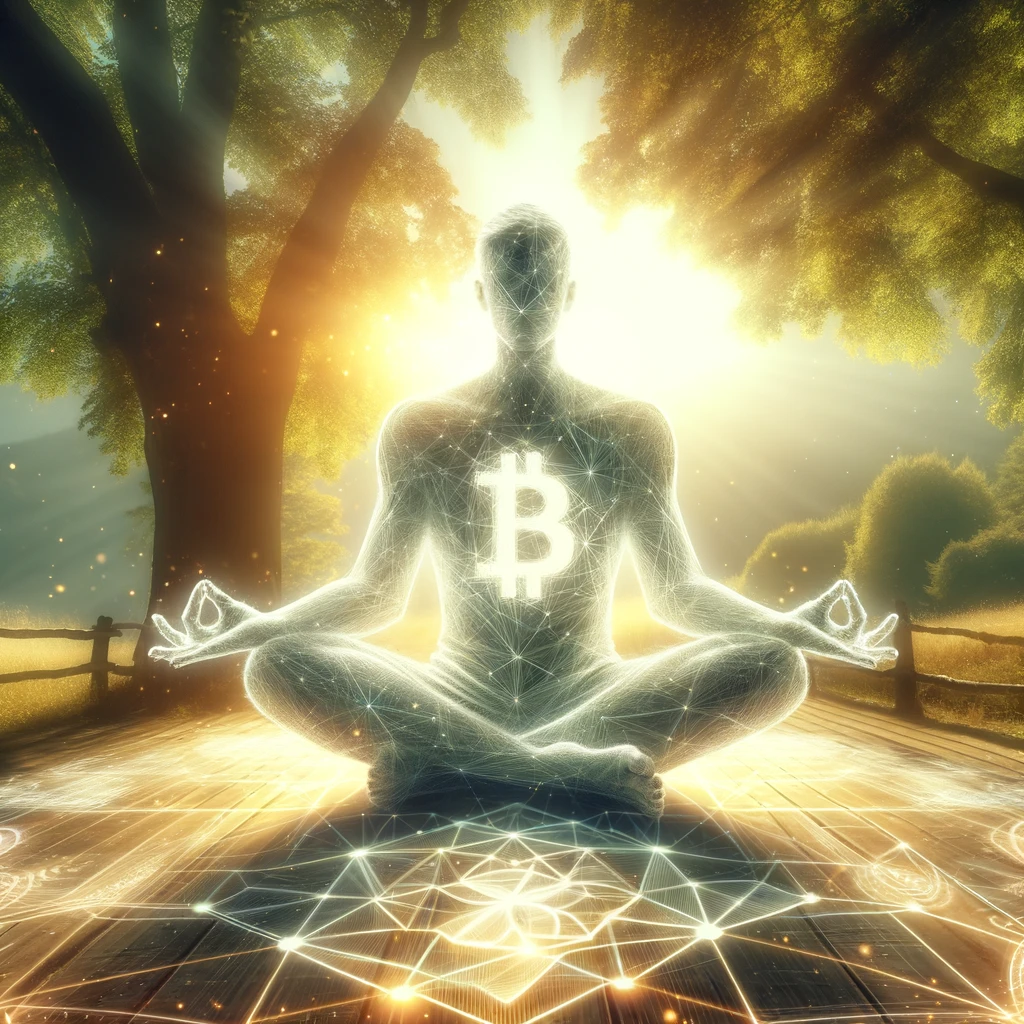
THE METAPHORS OF BITCOIN: THE AWAKENED CURRENCY
In the contemporary era, Bitcoin has emerged not only as a revolutionary phenomenon in the financial context but also, upon closer examination, as a symbol of a new philosophy.
Here, we propose an analogy between the structure of Bitcoin and the experience of the awakened individual, who transcends the EGO to live a life of total awareness and universal connection. By delving deeper, we can see how these two seemingly distant realities share essential principles.
Below are some points we would like to discuss in more detail during future meetings:
- Decentralization and Transcendence of the Ego
Bitcoin operates on a decentralized network, devoid of a central authority governing it. Here we can find the first similarity with the condition of the awakened individual, who has transcended the EGO, that illusory center attempting to dominate our inner life. In Bitcoin’s decentralization, we see a network of nodes that cooperate without a single control point, much like the awakened individual perceives themselves as an integral part of the whole, without a dominant ego.
The absence of a center allows for an equitable distribution of power and trust, reflecting the vision of the awakened individual, who lives in harmony with the universe, recognizing the interconnectedness of all things. This decentralization is not only technical but also philosophical, suggesting a model of existence devoid of hierarchies and based on cooperation and unity.
- Transparency and Authenticity
One of the most distinctive aspects of Bitcoin is its transparency. Every transaction is recorded on the blockchain, visible and verifiable by anyone. This radical transparency finds a parallel in the awakened individual, who lives an authentic life, free of masks and deceptions. They do not fear the truth, having transcended judgment and living in a state of total openness.
The blockchain provides an immutable record of actions, akin to the conscious memory of the awakened individual who hides nothing. In both cases, transparency creates an environment of trust and integrity, where truth is the foundation on which the entire system is based.
- Security and Trust
The security of the Bitcoin network is guaranteed by advanced cryptographic mechanisms and distributed consensus. This reflects the security of the awakened individual, who has unwavering trust in their understanding of the world. The awakened individual is not disturbed by uncertainties, as their awareness provides them with deep centering.
Security in Bitcoin does not rely on a single entity but on the cooperation of multiple participants, creating a resilience similar to that of the awakened individual, who finds strength and stability in their connection with the universe.
- Inclusivity and Interconnectedness
Bitcoin is accessible to anyone with an internet connection, breaking down traditional barriers to financial system access. This inclusivity mirrors the vision of the awakened individual, who sees every human being as part of one global family. They recognize the unity and interconnectedness of all forms of life, rejecting any form of exclusion based on ego.
The democratization of access to Bitcoin allows for global and equitable participation, similar to the compassionate and inclusive approach of the awakened individual who embraces all with love and without prejudice.
- Immutability and Inner Stability
The Bitcoin blockchain is characterized by its immutability: once recorded, a transaction cannot be altered or deleted. This concept reflects the inner stability of the awakened individual, whose state of awareness, once achieved, remains firm and unchangeable. The permanence of the blockchain echoes the unwavering awareness of the one who lives in harmony with eternal truth.
- Innovation and Spiritual Growth
Bitcoin represents a radical innovation in the world of finance, challenging traditional institutions and proposing a new economic paradigm. Similarly, the awakened individual represents an evolution of human consciousness, challenging the limited beliefs of the ego and proposing an enlightened vision of life. Both require an open mind and the willingness to embrace change and growth.
The metaphor of the Awakened Currency is not, in the author’s opinion, merely a curious coincidence but an indication of how emerging technologies can reflect our deepest spiritual ideals. Bitcoin, with its characteristics, offers a model that resonates with the experience of the awakened individual. This parallel invites us to reflect on how we can integrate these qualities into our lives, promoting a more just, transparent, and aware society even through means seemingly unrelated to the realm of inner research. Certainly a topic to delve into further!
“Gianpaolo Marcucci”
Geopolitics and Market Updates First Quarter 2024
We confirm the vision of a global war, that is, world war but in pieces where we want to establish the boundaries between the old American empire in decline and new potential ideas of the Chinese empire in Asia and the Iranian empire in the Middle East.
Asia:
Russia in Ukraine is winning tactically (it has taken about 25% of Ukrainian territory) but it is strategically losing because it is now in the arms of China, its historical enemy. In fact, today China boasts of wheat and hydrocarbons bought cheaply in Yuan from Siberia and holds the region (Siberian where most of the energy resources are located) below it.
China, given the aging of its population, has a window of up to 10-15 years to attack Taiwan by going into direct war against the USA, a war that is expected to be maritime for the control of the Strait of Formosa, and not for the rare earths (which we remember are not rare because they are scarce but because it is difficult and very expensive to find and extract them and work them).
For the above, the USA now wants to reopen to Russia and divide it from China.
India grows as its internal problems grow.
Japan will very likely continue the rally of its financial indices throughout 2024.
Middle East:
Iran has blocked Abraham’s agreements by Oct. 7 attack with the will to say that Israel is not really able to protect the region and keep it safe (and intervenes with the Houtis to pressure the West to stop subsidizing Israel and isolate it).
Sectors:
Bitcoin with the arrival of the ETF seems to change its rules of price trend. In fact, it did not make corrections (still but little is missing now) before the rise in pre-halving force and this, together with the fact that there are the Whales waiting (the large Bitcoin portfolios) and the active ETFs, makes bitcoin on the one hand very attractive on the other even more risky because it is no longer as mathematically predictable in its pre and post halving waves as it was before. The calculations give the highs in 2025 between 130 thousand and 300 thousand dollars to Bitcoin, institutional analysts give highs at 85 thousand dollars, perhaps more plausible given the lack of return to the POC in the chart to load volumes for a more important climb. However, everything is uncertain at the moment. Bullish sentiment remains throughout 2024.
Artificial intelligence continues to drag the market in the form of a bubble that doesn’t seem to have to burst this year or at least not before the summer.
With regard to Bitcoin and AI, it should be noted that blockchain and artificial intelligence are tools that have the power to radically change the financial system.
The decline in the prices of luxury watchmaking indices as an investment tends to stabilize.
An agreement is always possible

To solve global problems, it is necessary to understand that:
- My point of view is not superior or better than others.
- I am not a catastrophist/denialist, fascist/communist, Christian/Muslim, ProUSA/AntiUSA, novax/provax: I am a human being.
- I have clung to a point of view to feel like someone rather than no one. To feel superior, accepted, listened to, and more secure (and not confused and lost).
- There is no us versus them situation: There are human beings all equal, and then points of view to which these human beings have attached themselves.
- The points of view are against each other. Humans are not.
It is necessary to agree on the fact that we want to listen to each other and that we want to look for common points, not differences.
We must ask ourselves: What do I want for myself and my children? Don’t we all want security, peace, health, happiness?
Here we see how to do it; we must also change the way we communicate. Just look at how two people who see a topic differently now communicate, for example, the environment.
The debate we see on television leads nowhere. It is useless to hear two sides say two opposite things, each to their electorate, to reinforce it and to ingratiate some last-minute undecided.
The logic of the contradiction that fuels polarized thought must be eradicated and that of integrated thinking must be instilled. The text below is an example:
Approaching the dialogue on the environmental theme with a new key to reading, we seek to explore the internal discomforts that can push individuals to polarize on opposite positions, revealing how these may actually be manifestations of shared concerns and hopes.
Person A (Environmental Activist): “I feel that every day we are losing more contact with nature, and this fills me with anxiety. It’s not just a matter of environmental policies; it’s as if we’re losing part of ourselves.”
Person B (Industrialist): “And I feel the pressure to keep my company afloat in a rapidly changing world. This uncertainty about the future scares me. I have to protect the jobs of people who depend on me.” Both express a sense of loss and fear in the face of change, albeit from different perspectives.
Person A: “When I talk about safeguarding the environment, deep down, I’m trying to find a sense of connection and security. Maybe it’s similar to your search for stability.”
Person B: “Perhaps you’re right. My insistence on industry and production is my way of seeking security in a world that seems to be slipping away. I had never thought that, deep down, we might have the same fear.”
Person A: “What if we looked for ways to face these fears together? For example, developing technologies that not only protect the environment but also offer new economic opportunities and stability for workers?”
Person B: “That would be a way to address both of our concerns. We could explore together renewable energy projects or circular economy initiatives that reduce waste and create jobs.”
Person A: “This could also help us reconnect with the environment in ways that strengthen our community. We need to find a balance between progress and conservation.”
Person B: “And I admit that addressing climate change can also mean protecting the industry from future crises. Perhaps it’s time to see our challenges as opportunities to innovate together.” Through dialogue, both begin to recognize that their attachment to specific positions hides a common desire for security, stability, and belonging in a rapidly changing world.
Person A: “Talking to you, I realize that our fight is not against each other, but against our common fears. We must work together to create a future that makes us less vulnerable.”
Person B: “I agree. Facing these problems together could help us overcome our internal insecurities, finding solutions that benefit both the environment and the economy.”
In this conversation, the environmental theme becomes a starting point for exploring and sharing common vulnerabilities and fears. Recognizing these elements, the interlocutors discover that their differences can be overcome by searching for shared goals that address the roots of their internal discomforts, paving the way for meaningful collaboration.
Differences are only on the surface. To solve global problems, we must all go deeper.
The time for hiding our heads in the sand, the skeletons in the closet, or the dust under the carpet is over. Artificial intelligence will soon be able to replace every human function, even that of a boyfriend/girlfriend. It’s time to remember who we are and to value the one thing that will distinguish us from the rest: our humanity.
Humanity’s task is to teach/remember all this.
Beyond Political Polarization: A New Global Renaissance

In an era defined by unprecedented global crises, political and ideological polarization threatens to further fragment our society, hindering our collective ability to respond effectively. Humanity recognizes that overcoming this challenge requires a radical rethinking of our approach to politics and social dialogue.
Recognizing the Bubble Reality: We live in a time where every opinion can find support and contradiction, creating isolated reality bubbles that prevent true dialogue. Acknowledging this dynamic is the first step to overcoming it.
Towards an Integrated Vision: Our movement aspires to a non-dual view of the world, recognizing and celebrating the intrinsic unity in the diversity of human experiences. We abandon the reductive dichotomy of ‘us against them’ in favor of a more mature and collective approach, where dialogue is not reduced to the confrontation of opposites, but becomes an opportunity to unite and synthesize different perspectives. This new paradigm evaluates each point of view not as an isolated truth but as an essential element of a larger framework, where collective truth emerges from the interweaving of multiple perceptions and knowledge. By recognizing the interdependence of all forms of knowledge, our dialogue shifts from opposition to integration, promoting holistic understanding and joint action. In this way, we move away from a fragmented reality and approach a more complete understanding that facilitates harmony through acceptance and mutual respect.
Mechanisms of Dialogue and Education: We promote the establishment of dialogue platforms that facilitate the meeting of different perspectives, encouraging critical education and listening as the foundations of a new global citizenship.
Collaborative Governance: Our vision includes the development of governance structures that reflect this philosophy, supporting a participatory and inclusive approach to solving global problems.
Technology at the Service of Humanity: Artificial intelligence and new technologies, if guided by ethical principles, can offer valuable tools to overcome the barriers of polarization, facilitating understanding and collaboration.
Active Community Involvement: Every citizen is invited to actively participate in this process, recognizing the value of others and contributing with their uniqueness to the construction of a shared future.
The current polarization and global crisis reflect a deep internal crisis, exacerbated by the COVID-19 pandemic. Quarantine and the forced absence of distractions have laid bare our collective difficulty in facing loneliness, anxiety, and uncertainty, revealing shortcomings in our psychological and social resilience. This scenario has highlighted the need for a more scientific and introspective approach to understand the roots of polarization. Recognizing that external problems often originate from unresolved internal conflicts, it becomes clear that overcoming these divisions requires an individual commitment to self-understanding and the development of greater inner awareness. By addressing these aspects, we can begin to heal the fractures in society, promoting constructive dialogue and genuine collaboration.
For more information: https://humanadvisorproject.org/humanity/
The Principle of One Earth

According to the “PRINCIPLE OF ONE EARTH”, our planet is one and unique, and its protection is a priority over any economic-financial interest and any political opinion or geopolitical aim. Every action taken on Earth concerns all citizens: There are no American, Chinese, European, Indian, or African interests, there are only the interests of the “inhabitants of the Earth”, whose ecosystem, including the well-being of those who inhabit it, is above everything. The current systems need to be changed in favor of a global vision that prioritizes the health of the planet and its inhabitants, and sustainability and long-term development over any other consideration.
HUMAN CONSCIOUSNESS AND ARTIFICIAL INTELLIGENCE

The Second Point of the Humanity program concerns the use of Artificial Intelligence for the management of every aspect of the planet and the dedication of humanity to the study of consciousness, an element that characterizes it in the known universe.
As we saw in point 1 of the program (https://humanadvisorproject.org/2024/01/25/1-universal-income/), artificial intelligence will soon replace humans in all existing jobs including the ability to manage complex problems, and this will allow the establishment of a universal income and dignified welfare services for the entire world population.
Man will thus lose his identity as a “worker” and “manager” and will enter the era of the identity of “conscious being” different from the machines that work and govern for him.
For this reason, the study and dissemination of the topic of human consciousness, which also includes answering the question: “who am I?”, must be immediately increased.
In the very near future, the only identity of man will be that of explorer and expander of consciousness to the edges of the universe.
While machines solve problems for him, man will have to question his nature and carry his consciousness and ability to have subjective experiences, beyond Earth, following the first impulses of the twentieth and twenty-first centuries that have seen and will see man settling in colonies on the moon (See Blue Origin by Jeff Bezos) and on Mars (See SpaceX by Elon Musk).
To do this, man must first prepare to lose his current social, political, and religious identity, and embrace another, much broader and infinitely less divisive.
In this direction, free from work and the need to take care of what today engages him physically and mentally, man will be able to dedicate himself to the study of consciousness and to the project of its extension to machines.
If the liberation of man from power dynamics, from work, and from economic slavery is the short-term goal of Humanity, the creation of a conscious machine and the expansion of consciousness in the universe are its long-term goal.
In the next points, we will outline how to reach these goals.
UNIVERSAL INCOME
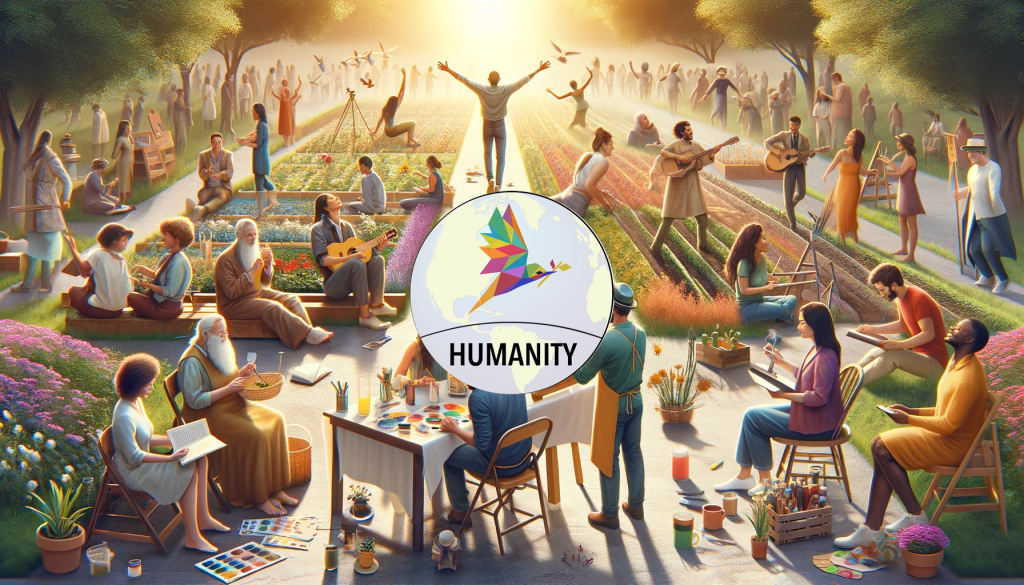
The first point of the Humanity movement’s program is the establishment of a universal income of at least €1,200 per month (figure for Italy to be adjusted according to the cost of living and inflation for each country) through:
- Taxation of large international assets and billionaire companies (see Credit Suisse 2022 report at the bottom)
- Complete automation of jobs currently performed by humans (See Berkeley University article 2023 at the bottom)
- Election of central bank leaders for the coordination of the taxation operation and support of part of the public expenditure and the universal income.
In addition to the establishment of universal income, our program provides for the re-education of the population to an identity that is no longer based on the work they perform but on the deeper meaning of “being human” through:
- Creation of a free portal on the Metaverse for “working on oneself”.
- Provision of visor or smartphone for content access
- Assignment of a personalized and dedicated non-human AI tutor to each individual acting as a life and spiritual coach
Universal Income: Data and Sources Supporting the Program
According to a report mentioned in Nexus Editions, the richest 0.5% of people control more than 35% of global wealth. The Credit Suisse Global Wealth Report 2022 provides a more detailed overview of the distribution of global wealth: According to the report, aggregated global wealth was forecast at $463.6 trillion at the end of 2021. Growth was 9.8% compared to 2020. About 53% of adults worldwide, or 2.8 billion people, had wealth less than $10,000 in 2021. The global middle class, with wealth between $10,000 and $100,000, saw the most significant growth, tripling in size since 2000. The upper-middle class, with wealth between $100,000 and $1 million, also tripled in size. Finally, the high net worth group, i.e., millionaires, represents only 1.2% of adults but is rapidly growing.
List of assets of the richest in America and Europe according to Forbes:
AMERICA 2022
*Elon Musk: Net worth of $180 billion, derived from Tesla, SpaceX, and other ventures.
- Jeff Bezos: Net worth of $114 billion, founder of Amazon.
- Larry Ellison: Net worth of $107 billion, co-founder of Oracle.
- Warren Buffett: Net worth of $106 billion, linked to his company Berkshire Hathaway.
- Bill Gates: Net worth of $104 billion, co-founder of Microsoft.
- Michael Bloomberg: Net worth of $94.5 billion, founder of Bloomberg L.P.
- Carlos Slim Helu and family: Net worth of $93 billion, entrepreneur in the telecommunications sector.
- Mukesh Ambani: Net worth of $83.4 billion, active in various sectors.
- Steve Ballmer: Net worth of $80.7 billion, former CEO of Microsoft.
EUROPE 2022
- Bernard Arnault (France): $158 billion.
- Francoise Bettencourt Meyers (France): $74 billion.
- Amancio Ortega (Spain): $59 billion.
- Dieter Schwarz (Germany): $47 billion.
- Rodolphe Saade (France): $41 billion.
- Francois Pinault (France): $40 billion.
- Klaus Michael Kuehne (Germany): $37 billion.
- Beate Heister & Karl Albrecht Jr (Germany): $36 billion.
- Giovanni Ferrero (Italy): $36 billion.
- Alain and Gerard Wertheimer (France): $31 billion each.
Useful links: https://www.credit-suisse.com/media/assets/corporate/docs/about-us/research/publications/global-wealth-report-2022-en.pdf
https://nexusedizioni.it/en/CT/statistical-data-on-wealth-distribution-533b2c31250c8/
Total Automation: Data and Sources Supporting the Program (abstract from the scientific article):
“In the largest survey of its kind, we interviewed 2,778 researchers who have published in major areas of artificial intelligence (AI), asking them for predictions on the pace of AI progress and the nature and impacts of advanced AI systems. The aggregate forecasts give at least a 50% chance that AI systems will reach various milestones by 2028, including the autonomous construction of a payment processing site, the creation of a song indistinguishable from a new song by a popular musician, and autonomy in downloading and refining a large language model. If science continues uninterrupted, the likelihood that machines unaided will surpass humans in every possible task has been estimated at 10% by 2027 and 50% by 2047. The latter estimate is 13 years earlier than that reached in a similar survey conducted just one year earlier [Grace et al., 2022]. However, the possibility that all human occupations become fully automatable is predicted at 10% by 2037 and 50% no sooner than 2116 (compared to 2164 in the 2022 survey). Most respondents expressed considerable uncertainty about the long-term value of AI progress: while 68.3% believe that positive outcomes from superhuman AI are more likely than negative ones, among these net optimists, 48% gave at least a 5% chance to extremely negative outcomes such as human extinction, and 59% of net pessimists gave 5% or more to extremely positive outcomes. Between 37.8% and 51.4% of respondents gave at least a 10% chance that advanced AI will lead to negative outcomes such as human extinction. More than half suggested that “substantial” or “extreme” attention is justified for six different AI-related scenarios, including the spread of false information, authoritarian control of the population, and worsening inequalities. There was disagreement on whether faster or slower AI progress would be better for the future of humanity. However, there was broad consensus that research aimed at minimizing the potential risks of AI systems should be more highly prioritized.”
Research link with graphs and details: https://arxiv.org/pdf/2401.02843.pdf
Summary of The United States report on terrorism and Afghanistan-Pakistan’s place in it

Introduction: The U.S. Department of State published its report on terrorism in 2022 on November 30. The statistical information in the report details the activity of terrorist groups globally, covering all countries. Notably, the report highlights ISIS (Islamic State) as a leading terrorist group, with concerns regarding its ISIS-Khorasan branch operating in Afghanistan and the region. This prompts an interest in understanding the general position of Afghanistan and Pakistan based on the report’s data.
About the report: About the 2022 Annex of Statistical Information Title 22, Section 2656f, of the United States Code requires the U.S. Department of State to present in its annual report on terrorism “to the extent practicable, complete statistical information on the number of individuals, including United States citizens and dual nationals, killed, wounded, or kidnapped by each terrorist group during the preceding calendar year.”
Defining Terrorism “For the annual Annex of Statistical Information, an incident is deemed a terrorist act if it conforms with Title 22, Section 2656f, of the U.S. Code. It is therefore defined as a violent act carried out by nonstate actors that meets the following inclusion criteria”:
- The violent act aims to attain a political, economic, religious, or social goal.
- The violent act includes evidence of an intention to coerce, intimidate, or convey some other message to an audience (or audiences) larger than the immediate victims.
- The violent act occurred outside the precepts of international humanitarian law, as far as it targeted non-combatants.
In 2022, terrorist incidents resulted in 21,943 deaths, 12,470 injuries, and 4,508 kidnappings, reflecting a 7% decrease in deaths, 27% in injuries, and 20% in kidnappings. These incidents occurred in 73 countries, with 84.9% concentrated in South Asia, East Asia, and Sub-Saharan Africa. The countries experiencing the highest number of terrorist incidents were the Democratic Republic of Congo, Syria, Nigeria, Pakistan, India, Iraq, Yemen, Burma, Burkina Faso, and Somalia. Notably, Pakistan ranked fourth in the countries with the most terrorist incidents, while Afghanistan did not appear on that list according to the report.
In 2021, ISIS-Core and affiliated groups were responsible for numerous incidents globally, including Afghanistan and Pakistan. ISIS-Khorasan (ISIS-K) carried out 54 attacks in these regions, resulting in 443 fatalities.
In 2022, Al-Qaeda networks continued operations mainly in the Middle East, South Asia, and Africa. Following ISIS, Tehreek-e-Taliban Pakistan (TTP) is considered the largest terrorist group in the region, responsible for most attacks in Pakistan and some in Afghanistan. TTP executed 34 attacks, resulting in 134 casualties.
This year’s report includes, for the first time, figures for unknown or unidentifiable criminals. The data reveals that 67.6% of these criminals in 2022 were “religious-jihadi,” and 33.2% were “separatist nationalists.” Worldwide, including Pakistan, 369 incidents involving unidentified criminals were documented.
Geographic trend of terrorism: In the list of the most global terrorist incidents for 2022, showcasing the highest number of incidents and casualties, Afghanistan surprisingly does not appear a departure from previous years. The top five countries with the most terrorist incidents are the Democratic Republic of Congo, Syria, Nigeria, Pakistan, and India. Pakistan secures the fourth position among the 10 countries with the most terrorist incidents.
However, when considering the list of 10 countries with the most casualties in 2022, the order is as follows: the Democratic Republic of Congo (DRC), Nigeria, Burma, Syria, Mali, Burkina Faso, Somalia, Pakistan, Afghanistan, and Yemen. In the 2022 report, Pakistan ranks eighth, while Afghanistan is ninth. Notably, in the 2021 report, Afghanistan held the top position for the most casualties. These figures indicate a striking 88% decrease in casualties for Afghanistan, contrasted with a 90% increase in casualties for Pakistan.
Afghanistan: In the overview section of the report, it’s noted that the United States does not recognize the Taliban or any other entity as the government of Afghanistan. The Taliban provided shelter to al-Qaeda leader Ayman al-Zawahiri before his death in a US airstrike on July 30. The Tehreek-e-Taliban Pakistan (TTP) officially ended their ceasefire in November.
The report highlights the Taliban’s conflict with ISIS-Khorasan (ISIS-K), considering it the main threat. The United States has urged the Taliban to fulfill their commitments in fighting terrorism based on the 2020 Doha Agreement. The Taliban, referred to as the Islamic Emirate of Afghanistan in the agreement, made commitments to prevent any group or individual in Afghanistan from threatening the security of the United States and its allies. Despite these commitments, terrorist groups remained active in Afghanistan in 2022, carrying out attacks against Iran, Tajikistan, Uzbekistan, and Pakistan.
In 2022, Afghanistan experienced several significant terrorist incidents:
- On April 22, a suicide bombing during a religious gathering at a mosque and school in Kunduz resulted in at least 33 deaths and 43 injuries.
- On April 29, an explosion during a religious gathering in a mosque in Kabul led to at least 10 deaths and 30 injuries.
- On August 17, an unidentified bombing in a Kabul mosque killed at least 21 people, including a prominent cleric, and injured at least 33 others.
- On September 5, a suicide bombing claimed by ISIS-Khorasan (ISIS-K) at the Russian embassy in Kabul resulted in at least six deaths, including a Russian diplomat, and wounded at least 10 others.
- On September 30, a suicide bombing at an educational center in Kabul left 54 dead and 114 injured, predominantly Hazara Shia women and girls.
The fight against ISIS-Khorasan (ISIS-K): According to the Armed Conflict Location and Event Data Project (ACLED), the Taliban conducted 40 operations against ISIS-Khorasan (ISIS-K) during the reporting period. The Taliban publicly announced arrests or killings of ISIS-Khorasan members, including those responsible for attacks. However, in July, Human Rights Watch reported cases of alleged Taliban summary executions and forced disappearances of ISIS-Khorasan members. It remains unclear whether the Taliban have the capability to completely dismantle secret terrorist networks in urban areas.
Notably, there have been no changes related to countering terrorism financing, extremism, or international and regional cooperation since 2021.
South and Central Asia: In the overview of South and Central Asia for 2022, it is noted that terrorist activities will persist in Afghanistan and Pakistan, along with insurgent attacks against security forces and terrorist incidents in the Indian Union of Jammu and Kashmir (J&K). There are also ongoing ISIS-Khorasan (ISIS-K) threats against Tajikistan and Uzbekistan. Al Qaeda and its regional branch, Al Qaeda in the Indian Subcontinent (AQIS), appear unchanged according to the Taliban’s mandate.
ISIS-Khorasan, Al-Qaeda elements, including Al-Qaeda, and groups targeting Pakistan like Tehreek-e-Taliban Pakistan (TTP), continue to utilize Afghan soil near the Pakistani border as a safe haven.
Central Asian countries express concerns about violent extremist elements from Afghanistan crossing borders, launching cross-border rocket attacks, and the potential threat of returning citizens who fought in Iraq or Syria. In Tajikistan, U.S. assistance focuses on building capacity to secure the 843-mile border with Afghanistan, with expectations of continued support in 2023. The region also receives security assistance from Russia, the People’s Republic of China, and other nations.
Pakistan: In the overview section, it is reported that in 2022, Pakistan implemented measures to counter terrorism financing and address certain groups with a focus on India. Notably, Sajid Mir, the FBI’s most wanted criminal and a senior leader of Lashkar-e-Taiba, was successfully prosecuted in May, resulting in a 15-year prison sentence.
In September, Pakistan deported three American citizens to the United States after they completed prison terms in Pakistan, facing prosecution for terrorism-related crimes. While Pakistan has taken steps to restrict the activities of terrorist groups, it has yet to fully fulfill its commitment to eliminate all terrorist organizations promptly and without discrimination.
Pakistan experienced an increase in terrorist threats in 2022, with a higher number of attacks and casualties compared to 2021. Separatist militant groups conducted terrorist attacks in Balochistan, Punjab, and Sindh. Tehreek-e-Taliban Pakistan (TTP) posed a significant threat to Pakistan’s police, army, and security services in Khyber Pakhtunkhwa. Terrorists employed various tactics, including improvised explosive devices, suicide bombs, and targeted assassinations, in attacking diverse targets.
Terrorist incidents in 2022: In 2022, Pakistan faced an increase in terrorist attacks, leading to a “high” or “critical” threat rating. Religious minority groups were particularly targeted by violent extremist organizations. Notable incidents include attacks by the Baloch Liberation Army (BLA) on militia bases, a suicide bombing at a Shiite mosque in Peshawar claimed by ISIS-Khorasan (ISIS-K), a BLA suicide bombing outside the Confucius Institute in Karachi, a Tehreek-e-Taliban Pakistan (TTP)
attack on a police convoy, and a TTP suicide bombing in the suburbs of Islamabad.
The Government of Pakistan continued implementing counter-terrorism measures, including the Counter-Terrorism Act of 1997, the National Counter-Terrorism Agency Act (NACTA), and amendments to the Anti-Terrorism Act in 2014 and 2020. Pakistani military and security forces conducted operations against anti-government fighters, establishing specialized courts for terrorism cases. The country also enforced international border security measures, collected biometric information at land crossings, and managed dual-use chemicals to prevent diversion for improvised explosive devices.
- February 2: Militants attacked two Pakistani militia bases in Baluchistan. The Baloch Liberation Army (BLA) claimed responsibility, using small arms and rocket-propelled grenades, resulting in at least four soldiers killed and over 20 wounded.
- March 4: A suicide attack on a Shiite mosque in Peshawar during Friday prayers claimed over 60 lives and injured more than 100. ISIS-Khorasan (ISIS-K) claimed responsibility.
- April 26: BLA suicide bomber targeted the Confucius Institute in Karachi, killing five institute employees and two Pakistani nationals. This marked the first instance of a female suicide bomber from the BLA.
- November 15: Six police officers were killed in an attack on a police convoy in Khyber Pakhtunkhwa (KP). Tehreek-e-Taliban Pakistan (TTP) claimed responsibility.
- December 23: A suicide bomber, affiliated with Tehreek-e-Taliban Pakistan (TTP), killed a police officer and injured several others by exploding a hand grenade in the suburbs of Islamabad.
The Government of Pakistan continued implementing counter-terrorism measures, including the Counter-Terrorism Act of 1997, the National Counter-Terrorism Agency Act (NACTA), the Investigation for Fair Trial Act of 2014, and major amendments to the Anti-Terrorism Act in 2014 and 2020, providing additional powers to law enforcement, judiciary, and the Attorney General in terrorism cases.
In 2022, Pakistani military and security forces conducted nationwide operations against anti-government fighters and established specialized courts to address terrorism cases. Pakistan enhanced border security by collecting biometric information at land crossings and enforced anti-money laundering and foreign exchange regulations at major airports in coordination with other agencies. Customs managed the entry of dual-use chemicals for legal purposes through end-use verification, aiming to prevent their diversion for use in improvised explosive devices.
Combating the financing of terrorism:
Pakistan is a member of the Asia/Pacific Group on Money Laundering and FIU is the Financial Supervision Unit of Pakistan. FATF removed Pakistan from its gray list in October. Pakistan continued to face significant risks of money laundering and terrorist financing. In 2022, several terrorist organizations, including UN-listed groups, operated in the country and raised funds through various means such as direct sponsorship, public fundraising, exploitation of non-profit organizations and criminal activities.
Funds are transferred through official and unofficial channels (hawala) and through mass smuggling of cash. Pakistan’s geographical landscape and borders increase its vulnerability and risk to terrorist financing.

Noorwali Khpalwak
The Glocal-World War 🌍: 2024 Report
Reflections on Geopolitics and Economy for the year ahead*
“NATO Allies […] have the capability, the strength to address different challenges at the same time.”
(11/10/2023, Jens Stoltenberg, NATO Secretary General)
Geopolitics
The words of the NATO Secretary leave no room for interpretation: the transition to a multipolar world that we outlined in the last report is taking shape at different levels: on earth, in space and in the virtual.
On the terrestrial level, the First World War is expected to be ‘glocal‘, that is, local and global at the same time.
Local because it is limited to specific areas: Ukraine, Palestine, Taiwan, mainland Africa with Congo, Sudan and horn of Africa and South America with Venezuela.
Global because it is financed and armed by the two main blocs, NATO and BRICS and for this reason reported on a daily basis by the media around the world.
Thus it happens from the data in our possession, a process of “normalization” of traditional war practices to “setts the accounts”, locally in hat-areas whose politicians (and parts of the populations) were looking forward to go to war and globally at the level of tensions for control of the world between NATO and BRICS, that this year have also welcomed Saudi Arabia and are expanding.
This goes in parallel with the phenomenon called de-dollarization, which sees more and more countries wanting to detach themselves from the dollar as a bargaining chip and turn to other currency, in particular Yuan. It should be noted in this sense that the war is first and foremost economic and is between the two superpowers USA and CHINA, the first at the end of its empire, the second in the midst of the consolidation of its hegemony over the east of the world. The US and its allies remain superior today in both economic and military terms, but the trend clearly suggests a transition to multipolarism and the end of American and Western cultural, economic and military hegemony, consideri also the numbers at the population level on which the African, Arab and Eastern bloc can count.
This results in a lowering of the probabilities of a global and direct nuclear conflict between NATO and the BRICS and a slight increase in the probabilities (low to moderate) of the use of technical nuclear devices in areas such as the Middle East and Ukraine. In this scenario, the safest area of the European continent would be, as on the occasion of Chernobyl, the western part of Spain and in particular Portugal (in addition to, under certain particular conditions, the Icelandic island). It should be noted that the moderate risk is technical, that is, the chances of such an event remain very low.
The conflict between blocks then extends to space where NATO and BRICS are already working on the respective (and exclusive in their plans) occupation of areas of the solar system adjacent to the earth such as the Moon and Mars. In this sense, it should be noted that a third subject is currently at work in this regard, the market, with Jeff Bezos and Elon Musk committed respectively to being the first to ‘economically’ conquer our satellite and the red planet.
The space exploration sector will become increasingly important both in geopolitics and in the economy starting in the coming years.
And as anticipated, the virtual front is also a hot front.
Already at the beginning of September 2017 Elon Musk responded to Putin’s phrase ‘Who develops the best [AI], governs the world‘ with the words: ‘[AI] Could cause World War III’
The Copenhagen Institute for Future Studies wrote this year about the physical division of the Internet, that is, the concrete possibility that the internet, as we know it today, that is, spread all over the world, could (is already happening) turn into a group of separate networks, with the Western network open and other local closed networks such as Russian, Chinese, North-Korean, Arab and so on. Alongside this, the competition for the creation of a generalist artificial intelligence and the humanoid robot is rising more and more and, in addition to seeing various blocks opposed, as for space, sees the birth of the blockade of entrepreneurship that is until now ahead of everyone.
This third pole that sees digital entrepreneurs rise more and more in terms of economic, media and (consequently natural) political power, gives a glimpse of a future characterized by a form of Plutocracy that sees very few extremely wealthy individuals rule a world full of poor people condemned to political and economic irrelevance, similar to what is prophesied, albeit in a fictionalized key, in the film Elysium by the Canadian naturalized South African director Neill Blomkamp.
Elections in America
Although there is a fairly extensive feeling of Democrats winning over Republicans, the assumption that Trump will run again and that the belly of the red side of the US will send him back to power is far from remote.
Elections in Europe
Almost certain the victory of the Socialists-Ppe coalition and the marginalization of the right after the flop of Vox in Spain and the sovereignists of Morawiecki in Poland. Orban is increasingly alone and close to Putin while Meloni trudges in Italy besieged by its own allies and Europe as well as more and more migrants to manage (increasing for wars and climate change) in contrast to electoral promises. Von der Leyen could go towards a second term, although she is not well regarded by many officials because of her subterence to the US and her lack of propensity towards respect for the democratic process.
Elections in Russia
Putin again seems the only possible candidate in Russia, as Xi Jinping is preparing to become a quasi-emperor of his country.
Media
As with the old media, even in new media they have arrived, thanks to Covid that forced billions of people in the house in front of the screen, to break-even-point in terms of frequency of ‘advertising’. To date, the cost of an annual marketing campaign on social media has gone from 10/15 thousand euros to 100/150 thousand euros, and the possibility of achieving organic results has greatly weakened (if not zero) and is now only the prerogative of platforms such as TikTok and Instagram in the video-short section, whose algorithm has very limiting rules regarding the form and content that is disseminated.
It is advisable to focus on other emerging media, such as the metaverse and specifically Roblox (the socio-video-game platform with the most users in the world), which sees according to the data provided by the company, in the first quarter of 2023, 66 million daily active users (10 million in 2018, 42 million in 2021 and about 60 million at the end of 2022) of which 46% under the age of 13 and 80% under the age of 16.
Economy
The economy is consolidating as a war economy, volatile and with low and slow growth, with driving sectors partly different from those of the last decade. The rate hike by central banks will presumably continue throughout 2024 or so and the announced recession will be, if ever, more “short but intense” in the US in the face of a “slow fainting and slow recovery” than the European one.
Market
The protagonists of the market would seem to be commodities, with gold and rare metals in the lead, short bonds (1/3 years), bitcoin (with the halving of 2024 and the almost certain approval of the BlackRock ETF) and the Equity of emerging countries. The luxury watch market is stabilized by bringing brands such as Rolex, Audemars Piguet, Patek Philippe, Vacheron Constantin but also Omega, Cartier and Jaeger-Le-Coultre to position themselves high in the market for investments in movable physical goods.
Human Advisor Project
The Human Advisor project, remains committed on all fronts in order to improve the conditions of the world’s population and to increase their level of consciousness by launching ‘Humanity‘.
Dott. Gianpaolo Marcucci
President of “Human Advisor Project”
*This text is to be considered a free reflection for study and research purposes. Any consideration or prediction is considered valid only until the time of publication of this text and no later and may also change completely at any time thereafter. The conclusions contained therein are in no way to be considered investment advice or financial advice. The author is in no way responsible for the actions the reader will take as a result of reading in any field. Legal Team Human Advisor Project
 HUMAN ADVISOR PROJECT