GLOBALIZATION IS CONTROL OF THE SEAS

To understand what is happening in the world today, we must start from a simple yet powerful idea: globalization is, above all, control of the seas. It is not just about trade, technology, or financial flows, but about the ability to ensure—or block—the free transit of goods and energy along the world’s major maritime routes.

History teaches this clearly. Every dominant empire has built its power through strategic control of the waters: Rome unified the Mediterranean, turning it into an internal lake—“mare nostrum”; the British Empire established naval bases across the globe, from the Suez Canal to Singapore; and finally, the United States, which since the end of World War II has dominated the oceans, sustaining the liberal global order with an unrivaled navy.

But no hegemony, however solid, remains unchallenged forever.

The American Empire in a Phase of Fatigue

Today, the United States still appears formally dominant, but less capable of exercising its authority unopposed. It is not so much a military weakness as a perceptual fatigue—a loss of confidence, both domestically and internationally, that creates room for other powers to rise. This perception—and the reality that follows—carries tremendous weight: in international relations, the perception of strength is already strength, just as the perception of weakness is already an invitation to challenge.

It is into this vacuum that determined actors are stepping: China, Russia, Turkey, and Iran, each carrying a worldview and, often, a historical empire to which they appeal to legitimize their expansion.

The Return of Empires

It is no coincidence that these emerging powers explicitly reference history. The United States sees itself as the heir to the British Empire—not just linguistically and culturally, but as a global maritime guardian. China, with its millennia-old civilization, has revived the Belt and Road Initiative, not only by land but especially by sea, building strategic ports from Asia to Africa. Russia aims to reconstruct a post-Soviet sphere of influence, supported by a czarist and Orthodox vision. Turkey, nostalgic for Ottoman glory, is now very active in the Eastern Mediterranean and Syria. And Iran presents itself as the spiritual and geopolitical heir of the Persian Empire, with a regional agenda aimed at shaping the broader Middle East.

These actors are not merely competing symbolically. They have concrete goals: regional influence, market access, energy control, and military presence in key global hotspots. And all of these goals, inevitably, pass through the sea.

The New Map of Power: Strategic Straits

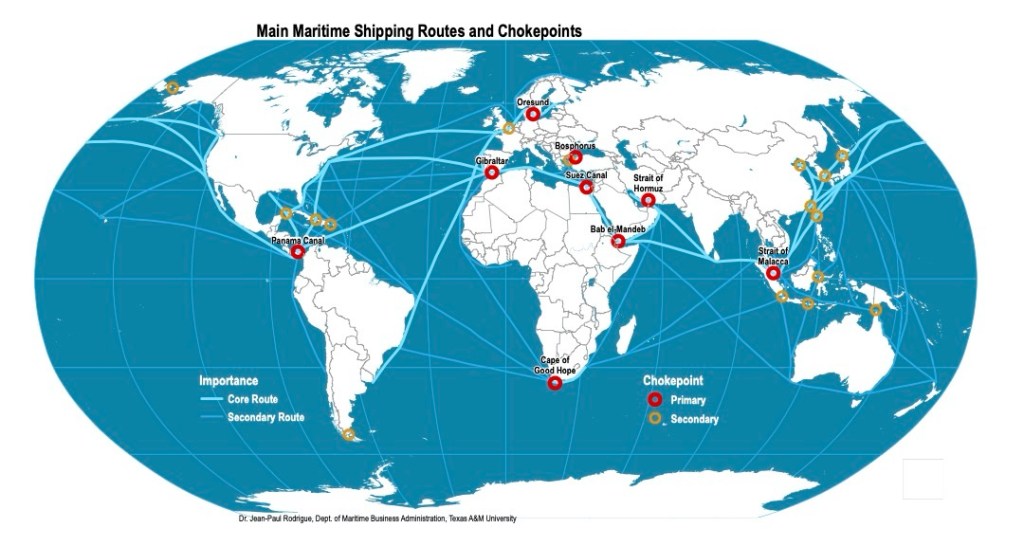
If the seas are the arteries of globalization, the straits are its vital points. They are narrow spaces where everything passes—and where everything can be blocked. This makes them the true fault lines of modern geopolitics.

The Suez Canal links Europe to Asia; even a partial closure causes immediate price shocks globally. The Bosporus and Dardanelles, controlled by Turkey, are essential for Russia and the entire Black Sea region. The Strait of Gibraltar remains a critical gateway to the Mediterranean. The Bab-el-Mandeb, between Yemen and the Horn of Africa, connects the Red Sea to the Indian Ocean, with direct consequences for European energy security.

The Strait of Hormuz may be the most delicate of all: nearly one-third of the world’s oil passes through it. Every Iran–U.S. tension plays out here as well. The Strait of Malacca, by contrast, is vital for China: a major portion of its trade flows through it, making it extremely sensitive in any potential conflict.

Further north, the Bering Strait—between Alaska and Siberia—gains relevance, not only symbolically as a frontier between two superpowers but also strategically in a world where Arctic routes are becoming navigable. Finally, the Taiwan Strait is now the epicenter of global tension: a geopolitical flashpoint where economic, technological, and military interests intersect.

Ongoing Wars: Symptoms of a Reordered World

Each current conflict can be interpreted as an attempt to redefine the global order. The war in Ukraine is not simply a clash between two states but a Russian challenge to NATO expansion and its own post-Soviet marginalization. In Syria, Turkey intervenes to control Kurdish dynamics and safeguard its regional influence. In Gaza, Iran strengthens its role in the anti-Israel axis and within the broader Middle Eastern theater.

Tensions around Taiwan may be the most dangerous: China claims the island as its own, and any attempt at reunification—even by force—would mark a critical turning point in its standoff with the United States. For now, Washington responds economically, using tariffs and technological restrictions in an effort to slow Chinese military and digital development without triggering open warfare.

A World Reassembling: Between Power, Narrative, and Perception

The Taiwan case is more than a territorial dispute. It is the symbolic center of a much broader challenge: that between two worldviews. On one side, a liberal, multilateral order led by the United States, which has provided decades of maritime stability and commercial growth. On the other, a new multipolar order in which emerging powers demand more space, influence, and control over strategic routes and global flows.

But the real battle is not just over who rules, but how reality is told and perceived. Narrative power matters as much as military power. China and Russia are not only challenging U.S. dominance at sea—they are also attacking its moral, cultural, and economic primacy. In this sense, the conflict also plays out in the minds of public opinion and in the diplomacy of neutral or non-aligned nations.

Globalization is not over—but it is changing its face. From an integrated, Western-led system, we are shifting to a more fragmented mosaic, where each power seeks to defend its sphere of influence, even at the expense of global cooperation. In this context, seas, straits, ports, and canals become arenas of strategic competition once again. It is the return of infrastructure geopolitics and chokepoint diplomacy.

Economic Impacts and New Financial Strategies

This new global context does not remain confined to diplomacy or armed conflict: it has direct and deep effects on financial markets. Wars, sanctions, naval blockades, geopolitical realignments, and trade tensions make future scenarios increasingly uncertain and volatile.

The consequences are visible across at least three dimensions:

1. Structural inflation: supply chain disruptions and the race for strategic self-sufficiency (in energy, tech, raw materials) are driving up global costs.

2. Market volatility: instability is growing—not only in countries directly involved in conflicts but at a systemic level.

3. End of the linear paradigm: predictable, steady growth models are becoming obsolete, prompting a fundamental rethink of risk itself.

In this setting, traditional passive investment strategies—like recurring index-based plans (e.g., PACs)—are showing their limitations. While still valid for long-term retail investors, they no longer suffice for those seeking resilience in a multipolar, high-entropy world.

Thus, we are witnessing a return—or rather a reinforcement—of more dynamic and adaptive approaches, such as those labeled “Absolute Return” strategies. These are not brand new: they have existed in institutional portfolios for decades. But their relevance increases in scenarios where the goal is not to beat the market, but to protect capital across all market phases.

Absolute Return strategies may include:

• Long/short instruments, which can profit in both rising and falling markets;

• Active hedging against inflation, volatility, or geopolitical shocks;

• Selective exposure to currencies, commodities, or assets uncorrelated with traditional markets.

Additionally, multi-strategy models are gaining traction—blending quantitative algorithms, macroeconomic analysis, and geopolitical intelligence—to deliver stable, non-cyclical returns.

In short: in a world where global powers are contesting control of the seas, investors must redraw their mental maps. Sailing blind is no longer an option, nor is following routes set by past textbooks. A new compass is needed—one capable of navigating not just quarterly earnings and equity indices, but the Strait of Hormuz, tech tariffs, and capital flows chasing the next strategic alliance.

Gianpaolo Marcucci

GLOBALIZATION IS CONTROL OF THE SEAS

To understand what is happening in the world today, we must start from a simple yet powerful idea: globalization is, above all, control of the seas. It is not just about trade, technology, or financial flows, but about the ability to ensure—or block—the free transit of goods and energy along the world’s major maritime routes.

History teaches this clearly. Every dominant empire has built its power through strategic control of the waters: Rome unified the Mediterranean, turning it into an internal lake—“mare nostrum”; the British Empire established naval bases across the globe, from the Suez Canal to Singapore; and finally, the United States, which since the end of World War II has dominated the oceans, sustaining the liberal global order with an unrivaled navy.

But no hegemony, however solid, remains unchallenged forever.

The American Empire in a Phase of Fatigue

Today, the United States still appears formally dominant, but less capable of exercising its authority unopposed. It is not so much a military weakness as a perceptual fatigue—a loss of confidence, both domestically and internationally, that creates room for other powers to rise. This perception—and the reality that follows—carries tremendous weight: in international relations, the perception of strength is already strength, just as the perception of weakness is already an invitation to challenge.

It is into this vacuum that determined actors are stepping: China, Russia, Turkey, and Iran, each carrying a worldview and, often, a historical empire to which they appeal to legitimize their expansion.

The Return of Empires

It is no coincidence that these emerging powers explicitly reference history. The United States sees itself as the heir to the British Empire—not just linguistically and culturally, but as a global maritime guardian. China, with its millennia-old civilization, has revived the Belt and Road Initiative, not only by land but especially by sea, building strategic ports from Asia to Africa. Russia aims to reconstruct a post-Soviet sphere of influence, supported by a czarist and Orthodox vision. Turkey, nostalgic for Ottoman glory, is now very active in the Eastern Mediterranean and Syria. And Iran presents itself as the spiritual and geopolitical heir of the Persian Empire, with a regional agenda aimed at shaping the broader Middle East.

These actors are not merely competing symbolically. They have concrete goals: regional influence, market access, energy control, and military presence in key global hotspots. And all of these goals, inevitably, pass through the sea.

The New Map of Power: Strategic Straits

If the seas are the arteries of globalization, the straits are its vital points. They are narrow spaces where everything passes—and where everything can be blocked. This makes them the true fault lines of modern geopolitics.

The Suez Canal links Europe to Asia; even a partial closure causes immediate price shocks globally. The Bosporus and Dardanelles, controlled by Turkey, are essential for Russia and the entire Black Sea region. The Strait of Gibraltar remains a critical gateway to the Mediterranean. The Bab-el-Mandeb, between Yemen and the Horn of Africa, connects the Red Sea to the Indian Ocean, with direct consequences for European energy security.

The Strait of Hormuz may be the most delicate of all: nearly one-third of the world’s oil passes through it. Every Iran–U.S. tension plays out here as well. The Strait of Malacca, by contrast, is vital for China: a major portion of its trade flows through it, making it extremely sensitive in any potential conflict.

Further north, the Bering Strait—between Alaska and Siberia—gains relevance, not only symbolically as a frontier between two superpowers but also strategically in a world where Arctic routes are becoming navigable. Finally, the Taiwan Strait is now the epicenter of global tension: a geopolitical flashpoint where economic, technological, and military interests intersect.

Ongoing Wars: Symptoms of a Reordered World

Each current conflict can be interpreted as an attempt to redefine the global order. The war in Ukraine is not simply a clash between two states but a Russian challenge to NATO expansion and its own post-Soviet marginalization. In Syria, Turkey intervenes to control Kurdish dynamics and safeguard its regional influence. In Gaza, Iran strengthens its role in the anti-Israel axis and within the broader Middle Eastern theater.

Tensions around Taiwan may be the most dangerous: China claims the island as its own, and any attempt at reunification—even by force—would mark a critical turning point in its standoff with the United States. For now, Washington responds economically, using tariffs and technological restrictions in an effort to slow Chinese military and digital development without triggering open warfare.

A World Reassembling: Between Power, Narrative, and Perception

The Taiwan case is more than a territorial dispute. It is the symbolic center of a much broader challenge: that between two worldviews. On one side, a liberal, multilateral order led by the United States, which has provided decades of maritime stability and commercial growth. On the other, a new multipolar order in which emerging powers demand more space, influence, and control over strategic routes and global flows.

But the real battle is not just over who rules, but how reality is told and perceived. Narrative power matters as much as military power. China and Russia are not only challenging U.S. dominance at sea—they are also attacking its moral, cultural, and economic primacy. In this sense, the conflict also plays out in the minds of public opinion and in the diplomacy of neutral or non-aligned nations.

Globalization is not over—but it is changing its face. From an integrated, Western-led system, we are shifting to a more fragmented mosaic, where each power seeks to defend its sphere of influence, even at the expense of global cooperation. In this context, seas, straits, ports, and canals become arenas of strategic competition once again. It is the return of infrastructure geopolitics and chokepoint diplomacy.

Economic Impacts and New Financial Strategies

This new global context does not remain confined to diplomacy or armed conflict: it has direct and deep effects on financial markets. Wars, sanctions, naval blockades, geopolitical realignments, and trade tensions make future scenarios increasingly uncertain and volatile.

The consequences are visible across at least three dimensions:

1. Structural inflation: supply chain disruptions and the race for strategic self-sufficiency (in energy, tech, raw materials) are driving up global costs.

2. Market volatility: instability is growing—not only in countries directly involved in conflicts but at a systemic level.

3. End of the linear paradigm: predictable, steady growth models are becoming obsolete, prompting a fundamental rethink of risk itself.

In this setting, traditional passive investment strategies—like recurring index-based plans (e.g., PACs)—are showing their limitations. While still valid for long-term retail investors, they no longer suffice for those seeking resilience in a multipolar, high-entropy world.

Thus, we are witnessing a return—or rather a reinforcement—of more dynamic and adaptive approaches, such as those labeled “Absolute Return” strategies. These are not brand new: they have existed in institutional portfolios for decades. But their relevance increases in scenarios where the goal is not to beat the market, but to protect capital across all market phases.

Absolute Return strategies may include:

• Long/short instruments, which can profit in both rising and falling markets;

• Active hedging against inflation, volatility, or geopolitical shocks;

• Selective exposure to currencies, commodities, or assets uncorrelated with traditional markets.

Additionally, multi-strategy models are gaining traction—blending quantitative algorithms, macroeconomic analysis, and geopolitical intelligence—to deliver stable, non-cyclical returns.

In short: in a world where global powers are contesting control of the seas, investors must redraw their mental maps. Sailing blind is no longer an option, nor is following routes set by past textbooks. A new compass is needed—one capable of navigating not just quarterly earnings and equity indices, but the Strait of Hormuz, tech tariffs, and capital flows chasing the next strategic alliance.

Gianpaolo Marcucci

A Multipolar World 🌍

Reflections on Economy, Market and Society for the year to come*

The Human Advisor Project proposes some reflections on the year that is about to come. It is recommended to read the disclaimer note at the end of the text. The report is divided into short and summary paragraphs, please request in the comment section if you would like to deepen one or more of the topics below in future reports and articles. Let’s get started.

The evolution of Globalization

The era of the West as the center of the world is over. The new trend now, in the West, will be to consider the world as a two-pole world with a democratic bloc and an authoritarian bloc. However, this seems to be an overly simplistic and naive definition. The rise of alternative powers to the two US-CHINA blocs seems to be foreshadowing an evolution in the direction of a multipolar world within which exchanges of resources and services will continue both between blocs and within the blocs. The market will suffer from the moment of tension caused by this change, but in the long run it will benefit. Nationalist and populist movements will be able to arise and proliferate temporarily in the initial phase of this process, but clashing with the economic needs of global market union that will make them mature and/or lose ground in the medium and long term. It is also noteworthy that we are preparing to reach 10 billion people on planet earth in a few years, with all the challenges in terms of food supply, population density, migration, security, energy and pollution that this will bring.

Climate change and social justice

From Cop27, some main scenarios have emerged:
There is no agreement at global level on how to reduce emissions.
Europe is a leader in regulation with the US, which could supplant it as early as this year. At the moment, the focus seems to be on the rebalancing of social justice between developed and emerging countries, to the extent that the west will have to (would they already have to?) create and/or support the emerging countries in the process of adaptation to current climatic conditions (provoked mainly by the developed countries). A Cop28 more focused on decarbonization is expected next year.

War in Ukraine as a regional and non-world war

The war in Ukraine that seemed to result in a world-nuclear-war in the second quarter of 2022, now appears to have stabilized as a ‘regional’ war, only European. The consequences on the rest of the world are visible but not as much as if it had broken out a few decades ago. This makes us reflect on the role of an increasingly less central Europe at world level, that is, more and more a single subject among a multitude of subjects, political, economic and military, within a multipolar world. This war is to be considered, anyway, as a War between USA and China, but the conflict should not lead to a Nuclear world (even tough it could be announced as possible to destabilized political order in the Euro-Asiatic continent).

The future monetary war

Strong dollar, weak euro, and other raising currencies. The Chinese digital currency is in the pipeline, which wants to become the main exchange currency of the BRICS countries (which would also like to incorporate Dubai). All this monetary ferment seems to foreshadow a future currency war. Among these currencies, one certainly represents the most ambiguous but interesting: Bitcoin. Much down from last year’s highs but very high compared to its pre-covid levels, with its strong assumptions and projections still very promising in the long term, despite the expensive and polluting mining issue. A war between Fiat currencies and Bitcoin can become reality but for now it prevails the Central Banks will of just regulating the crypto sector and set the ground for a mutual existence in future of both systems.

Inflation and Central Banks

Inflation (to 70% due to the increase in the cost of food and energy due to the war in Ukraine) is the big issue of these last months. The loss of purchasing power of households is beginning to be felt and, while in America there is already talk of the ‘beginning of the end of inflation’, in Europe, although it seems that the peak has reached, high inflation will still seem to remain present throughout 2023, thus impacting the cost of living and eroding uninvested savings or money on the current accounts of savers. Central banks are running for cover, in fact, the FED and the ECB seem to want to continue to use the hard fist, raising interest rates on the money lent to the banks, which consequently raise mortgage rates, thus triggering a difficult situation for businesses and citizens. At the moment, inflation forecasts are not rosy for Europe. To run for cover, many think of lightening their liquidity by investing in the rising bond market or buying Real Estate, mainly in the ‘Logistics’ and Private Luxury sector (a big “No” for the commercial real estate sector in sharp devaluation from the pandemic).

Bear market

It is given by everyone as certain a more contained growth in the two-year period 2023/2024 with a “bear” or dormant market, or even in a slight decline in Europe (recession) and very light or absent in the USA. This would represent a significant disadvantage for investors who opened their market positions in 2021 who are now losing double-digit percentages, but a considerable advantage for those who want to open them (especially in solid stock) positions in the next year by buying on weaknesses. Bear market could still be a reality in 2024.

Luxury

The crisis, as always, is not felt by the richest groups of society, which are becoming richer and richer and who, even driven by inflation, tend less and less to take liquidity on account and prefer to spend, and sometimes even invest, in the luxury sector. Although down from last year due to the war in Ukraine, buying a Rolex still means doubling if not tripling your investment at the exact time of purchase. In fact, a Steel Daytona purchased today at 12K€ from that elité that has access to the waiting lists of retailers, can be exchanged in the gray watch market for about 25/30K€. Watches thus become no longer tools but jewels: Swiss watchmaking houses are increasingly shifting towards the use of precious metals and sought-after mechanisms, raising customer entry-level prices to 20/30 thousand euros (comes to 7/8 a few years ago). This is also because of the total absorption of the market for ‘technical’ or ‘instrumental’ watches by the tech industry. Suffice it to say that Apple alone sells more watches per year comparing to the entire Swiss industry put together. Apple has recently come out with the first model of diving and hiking smartwatch. It is thus expected a gradual distancing of the Swiss industry from the ‘stainless steel’ to the luxury good in gold and diamonds or platinum (and an overvaluation of the Vintage given the poor availability of some models).

Layoffs, BigTech Crisis and Labour Market

However, very few are those who can afford to buy luxury goods, especially given the drastic increase in layoffs in the world due to the fear of recession and the bear market. In fact, the bear market bogeyman seems to have pushed the American technological giants to fire tens of thousands of workers. However, in the opinion of many analysts, this is not a strange fact, but a healthy and natural evolution of such companies that evidently, after a period of unicorn traction and over-price on the stock market, due to their boom and post-pandemic, begin to become more mature, solid, well-managed and therefore promising companies in the long term (and less volatile). Clearly this is devastating from the point of view of the workers concerned, but only if you think of the world of work in the ‘ancient’ way or the way in which it is necessary to work for a living. As automation is constantly advancing, the future scenario that is now facing with certainty is that of increasingly automated work and the creation of alternative subsidy tools to work such as universal income or UBI (Universal Basic Income). In this sense, Germany has begun working on the creation of a citizenship income to cover the loss of jobs of German citizens. Jobs that probably, in many cases, will not be get back. In contrast to Italy, which abolishes its already precarious citizenship income, but more for ideological reasons it seems and without putting tangible alternatives at the moment. So strong social and humanitarian crises are expected even in the West due to the reticence of the legislators to regularize this practice of “monthly non-repayable survival allowance” by the state to every citizen who will be (in academic circles and among the elité of American entrepreneurs it has already been mentioned for years as the only solution to unemployment from automation) the formula. 

Millennials and GenerationZ

Two generations face the world of work. Millennials and GenerazioneZ are the workers/citizens/leaders-politicians/entrepreneurs/investors of the present/future. In order to understand how these generations will approach business, economic, financial, social and political life, we must first consider what we know about them. Of the millennials (born between 1981 and 1996) we know that they are the most educated generation ever. This on the one hand pushes them to think they ‘already know everything’ even when in reality this is not the case. On the other hand, it pushes them to want to distinguish themselves, to want to emerge and to increase their wealth, cognitive, experiential, consumerist and financial. They are also very politicised in different countries of the world, but that is not necessarily why they are recognised in mainstream politics. Of GenerationZ (born between 1997 and 2012) what we know is that they are babies born with the ‘screen in the cradle’. They have never seen a program on television or read a paper newspaper and everything for them exists more in the virtual than in the real one, in the present extemporaneous rather than in the planned future. Social interactions are predominantly mediated between them by the technological medium, via chat (phone calls are considered an invasion). Their private sphere is very wide and the level of comfort they are used to is very high. Their attention lasts no more than 8 seconds and the enjoyment of one content for them is difficult to go beyond 15 minutes. GenerationZ is likely to be renamed CyberGeneration. The next one will continue that trend. 

Metaverse

In this perspective, the space for the birth of a new world is foreshadowed, first only imagined in science fiction novels and today already partial reality: the Metaverse. Meta, whose stock is down sharply today due to non-return spending policy, is the most interesting company to look at in this regard. It is in fact creating the platform and the device (i.e. software and hardware) through which all internet users in a medium and long-term time horizon will interface with the network for activities such as working, communicating, socializing, having fun, enjoying entertainment content (including those for adults), playing sports and much more. All from home, in your own comfort zone and without invading your private sphere, in line with the needs of GenerazioneZ. Other companies are chasing Meta in both America and China. Possible mergers are on the horizon in my opinion, so you will have to be careful, but investing in this sector (wide and not mono-company), over a time horizon of 10/15 years, could give very high returns.

Market prospects: crisis/opportunity

In addition to the metaverse and cryptocurrencies today at attractive prices, there are other interesting prospects in the market in my opinion:
EM Asia: The emerging countries of Asia and the Pacific are, according to almost all reports, the driving economies of the coming years followed by Nigeria (still risky and too immature politically).
Health care (home diagnosis and oncology immunology): In the health sector, there are excellent potential results in the medium to long term with regard to DIY diagnostics (home devices connected to the smartphone) and oncology immunology (cancer vaccines).
Pet: A close eye should be given to the sector that concerns pets and everything that revolves around them. In sharp rise and with great future potential.
Bond: Fixed coupon bonds are back. Certainly the most cautious investors will make use of it. Beware, however, to the fact that compared to the Bonds of a few years ago, these have some little more risks. It is therefore better to be cautious and always diversify.

The commitment of the HAP in the world: Ukraine Africa and Afghanistan 

Our commitment abroad remains strong on three fronts:
Ukraine: The situation of internal refugees, that is, the people who have been left homeless for the war, is very serious. The most important thing now is for us to intervene not only on a psychological but also socio-economic level. The people, as had been predicted by our report sent to President Draghi last February, have suffered devastating damage on all levels. It is necessary at this time to rehabilitate them psychologically but also to reintegrate them from a social and work point of view. Innovative poles must be created scattered throughout western Ukraine (it is possible that for a period there will be two Ukraines) where IDPs (internal disposable person) can start from scratch in safety and therefore live, work and socialize. Our head of Ukraine Emergency Dr. Viktor Vus now in Kiev is already on the front line on this front and in constant contact with me.
Africa: As far as the African continent is concerned, we have decided to focus on Rwanda and work on supporting adolescent mothers. Girls aged 13 to 18 who got pregnant due to rape or absence of sex education and who now find themselves being minors with minors dependent on them, no economic resources and no education. We will work to improve their conditions. Dr. Ronald Kimuli, head of Human Advisor Project Africa is already operational in this regard and in constant contact with me. 
Afghanistan: The situation in Afghanistan is disastrous. There are parents forced to drug their children to make them sleep. There is no food, there is no infrastructure and many have lost their homes as a result of natural disasters. As much as the issue of education is central to us in a country like Afghanistan, as can be seen from our policy paper, we are now focusing first on humanitarian aid. Dr. Noorwali Khpalwak is operating from Paris and we have a team on site in Kabul in constant contact with us led by Dr. Samiullah Ahmadzai.

The next summary report will presumably be published at the end of next year.

Dott. Gianpaolo Marcucci

President of the “Human Advisor Project”

*This text is to be considered a free reflection for study and research purposes. It is not to be considered scientific, commercial or informative material nor does it necessarily represent the thought of Gianpaolo Marcucci or the Human Advisor Project. Any consideration or forecast is considered valid only until the time of publication of this text i.e. November 30, 2022 at 14:00 GMT+1 and no later and may also change completely at any time thereafter. The conclusions reported in it were elaborated following studies and analysis of written, audio, video materials and reports from specialized institutes such as: CIFS, ISPI, Julius Bär, JP Morgan, Goldman Sachs, Morgan Stanley, Bloomberg, Financial Times, Wall Street Journal, Sole 24 ore, Il fatto Quotidiano. Neither Gianpaolo Marcucci nor the Human Advisor Project is in any way responsible for the actions the reader will take as a result of reading this document. For additional info: Legal Team Human Advisor Project

Author: Gianpaolo Marcucci

Afghanistan Needs Voice

The international community’s silence on the humanitarian crisis, terrorist activities and human rights in Afghanistan is worrying. We’ve just receive report of many rights violated:

– Closure of schools for girls;

Although it has been almost a month since the start of the schools in Afghanistan, girls above the sixth class are still not allowed to go to school. A number of political parties, civil society groups and tribal councils in Kabul have called on the Taliban to reopen girls schools as soon as possible and not to allow girls’ schools in Afghanistan to remain closed. The political parties, civil society and tribal councils have issued a statement saying that girls education is red line of the people of Afghanistan and the doors of the schools should not remain closed for girls anymore. They also warned that closed schools for girls would force people to migrate, causing severe economic and political damage to the country.

– Two out of three children in Afghanistan do not have access to adequate food:

Business Standard publication wrote an article quoting international foundations about the fact that the raising hunger and poverty in Afghanistan have had a direct negative impact on the lives of children. Two out of three Afghan children do not have access to adequate food: The source said that the current situation is terrible and the families have been forced to sell their children or force them to do hard labor to get dome money for survival expenses. The International Children’s Fund, or Save the Children, also estimates that nearly five million Afghan children are starving. The agency also noted that the current drought in Afghanistan, political and economic conflicts and the suspension of international aid have affected services for children such as education, health and food security. According to various UN agencies, about 95 percent of Afghans do not have enough food, and children and women are the main culprits.

– Security and political crisis:

The wave of suicide attacks and bombings in the country has generated fear of Afghanistan falling into the hands of terrorist groups. There have been several deadly attacks in Kabul, Balkh and Kunduz in the past few days. A recent attack on civilians targeted a mosque in the Imam Sahib district of Kunduz province, killing more than 40 people and injuring more 50 people. Earlier a mosque in Mazar-e-Sharif and an education center in Kabul were drugged, killing and injuring dozens. The killings of Hazaras and Shiites are the latest wave of violence, and the militant groups currently fighting in Afghanistan are slowly spiraling out of control. Over the past 20 years, they have maintained close ties with al Qaeda, ISIS, the Islamic Movement of Uzbekistan, the East Turkestan Islamic Movement, the Pakistani Taliban, and Lashkar-e-Taiba. Theese groups sees opportunity of rebuild their ranks for West and Central Asia.

Afghanistan is once again at the center of jihadi extremism, The firing of 10 missiles by ISIS on Uzbekistan last week sends a message that the groups are trying to destabilize Afghanistan’s neighbors, which destroyed the geopolitical situation of the region. Economic stagnation, harsh sanctions, exclusion of women and girls from human rights, and the legal vacuum will once again turning Afghanistan into an exporter of terrorism. Recent attacks on civilian targets in Afghanistan have been condemned by many countries and political institutions. The United Nations Assistance Mission in Kabul (UNAMA), Amnesty International, Human Rights Watch, the Norwegian delegation to the United Nations, the United Arab Emirates and a number of other governments and international organizations expressed sorrow over the recent attacks, which killed and injured hundreds of civilians. But humanitarian aid and condemnation of incidents alone cannot solve the problem of Afghans, Humanitarian aid is good, it solves the urgent needs of the people, condemnation of incidents is also a moral generator of courage and hope.

But we must not forget that the security situation in Afghanistan, has a direct impact to the whole world, especially on the region. After the war in Ukraine, Afghanistan seems to have been overlooked by the international community, which will have dire consequences in the future. The international community must not allow this country to once again become a breeding ground for terrorism and terrorist groups to once again become a source of profit for pro-government. It is necessary to find permanent solutions to help Afghanistan achieve sustainable economic growth and save the lives of millions of people. It is needed a structure to connect Afghanistan to the world and establish an agreement between Afghanistan and the U.N. about human rights, women rights, freedom of speech and all the values a democracy need, to prevent a humanitarian catastrophe.

Noorwali Khpalwak, Afghan Journalist, Human Advisor Afghanistan

Questo blog non rappresenta una testata giornalistica in quanto viene aggiornato senza alcuna periodicità . Non può pertanto considerarsi un prodotto editoriale ai sensi della legge n° 62 del 7.03.2001. L’autore non è responsabile per quanto pubblicato dai lettori nei commenti ad ogni post.Verranno cancellati i commenti ritenuti offensivi o lesivi dell’immagine o dell’onorabilità di terzi, di genere spam, razzisti o che contengano dati personali non conformi al rispetto delle norme sulla Privacy. Alcuni testi o immagini inserite in questo blog sono tratte da internet e, pertanto, considerate di pubblico dominio; qualora la loro pubblicazione violasse eventuali diritti d’autore, vogliate comunicarlo via email. Saranno immediatamente rimossi.L’autore del blog non è responsabile dei siti collegati tramite link né del loro contenuto che può essere soggetto a variazioni nel tempo. Di ogni contenuto è responsabile solo l’autore del post.
This blog is not a newspaper as it is updated without any periodicity. It cannot therefore be considered an editorial product within the meaning of Law No. 62 of 7.03.2001.The author is not responsible for what is published by the readers in the comments to each post. Comments deemed offensive or harmful to the image or good repute of third parties, of spam, racist or that contain personal data that does not comply with the Privacy Policy will be deleted.Some texts or images included in this blog are taken from the internet and, therefore, considered in the public domain; if their publication violates any copyright, please communicate it by email. They will be removed immediately. The author of the blog is not responsible for linked sites or their content which may be subject to change over time. Only the author of the post is responsible for the content.